
What Is Tree Cabling?


What is tree cabling? It is a structural support technique where a certified arborist installs high-strength cables between major branches or from the trunk to a higher anchor point in the canopy. The short answer on whether it can save a leaning tree: sometimes yes, sometimes no – and knowing the difference matters before you spend money on hardware that will not fix the actual problem.

Cabling is one of the most effective tools in an arborist’s toolkit when it is used on the right tree. It is also one of the most misapplied. Here is an honest look at how it works, when it makes sense, and when removal is the smarter call for your NYC property.
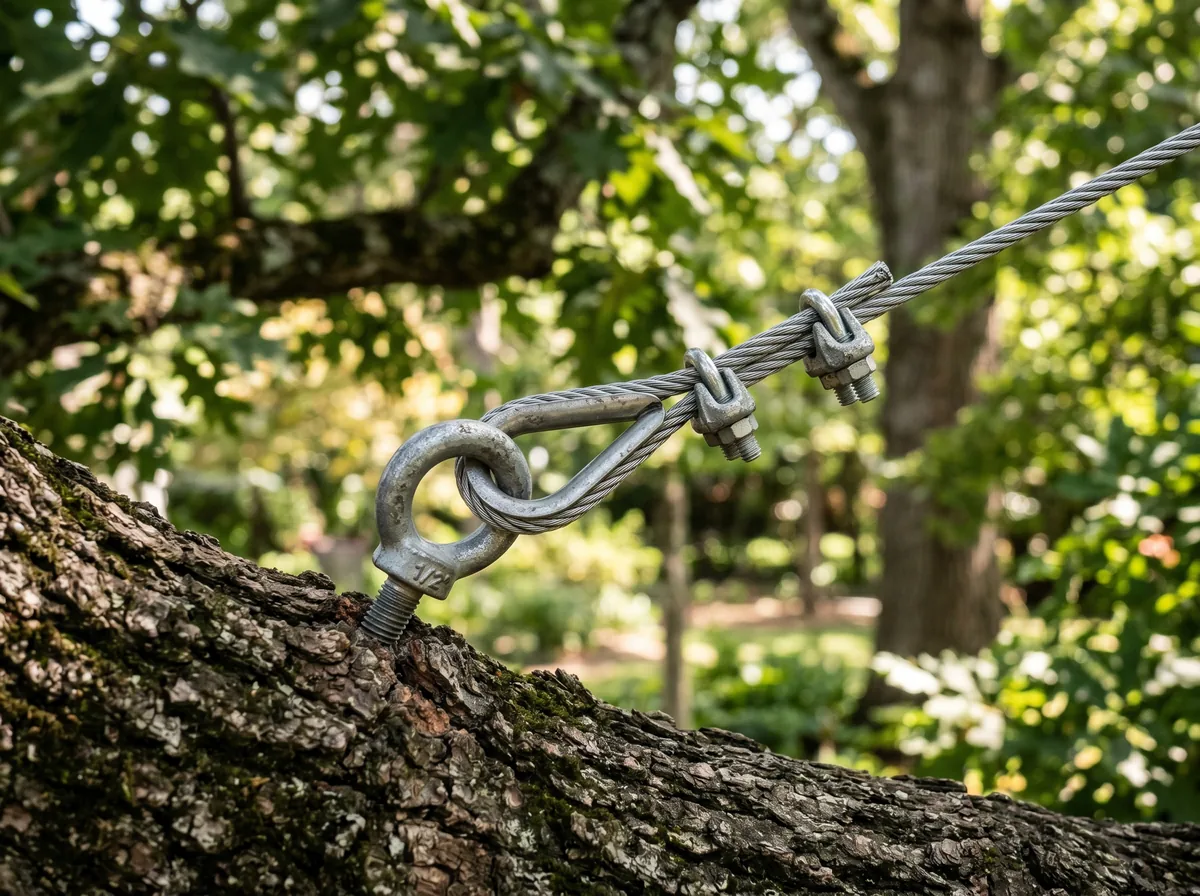
Close-up of steel cable and eyebolt hardware installed on a tree branch as part of a cabling support system
Static cabling systems use galvanized steel hardware anchored directly into the branch wood


What Tree Cabling Actually Is

At its core, tree cabling is about redistributing stress. Trees develop structural weaknesses over time – heavy branches that have grown too long, co-dominant stems that form weak V-shaped unions, or leaning trunks where uneven growth has shifted the center of gravity. Cables installed between these points limit how far branches can swing during storms and transfer some of the load away from the weak point.

A related technique called bracing uses threaded steel rods installed horizontally through co-dominant stems to physically prevent them from splitting apart at the union. Cabling and bracing are often used together: the brace rod addresses the crotch itself, the cable addresses movement in the canopy above it.

Static vs Dynamic Cabling Systems

There are two main categories of cabling, and they behave very differently:

  • Static cabling uses galvanized steel cables with hardware – eyebolts, thimbles, and cable clamps – installed directly into the branch wood. It limits movement rigidly and is the traditional approach for high-risk situations.
  • Dynamic cabling uses synthetic ropes or webbing attached with friction knots or low-impact anchors. It allows more natural sway while still limiting extreme movement. Dynamic systems put less stress on the anchor points and are preferred when the goal is long-term tree health over maximum rigidity.

ISA-certified arborists generally follow the guidelines published by the American National Standards Institute (ANSI A300) when selecting and installing cabling systems. The choice between static and dynamic depends on the tree’s species, the severity of the structural issue, and what the property owner’s goals are.

Cable and Bracing

Signs a Tree is a Good Cabling Candidate

Not every weak tree is a cabling candidate. The technique works best when specific conditions are present:

  • The root system is intact and healthy. Cabling addresses structural weakness above ground. If the roots are compromised, the foundation is already failing and cables will not fix it.
  • The lean developed slowly over years – not suddenly after a storm. Gradual leans often indicate directional growth toward light, not structural failure.
  • The structural weakness is in the upper canopy, at a specific branch union, not in the trunk itself.
  • Less than 30% of the canopy is dead or in decline. A tree in general decline is not a cabling candidate; it is a removal candidate.
  • The tree has significant value – heritage, aesthetic, or ecological – that justifies the investment in long-term maintenance.
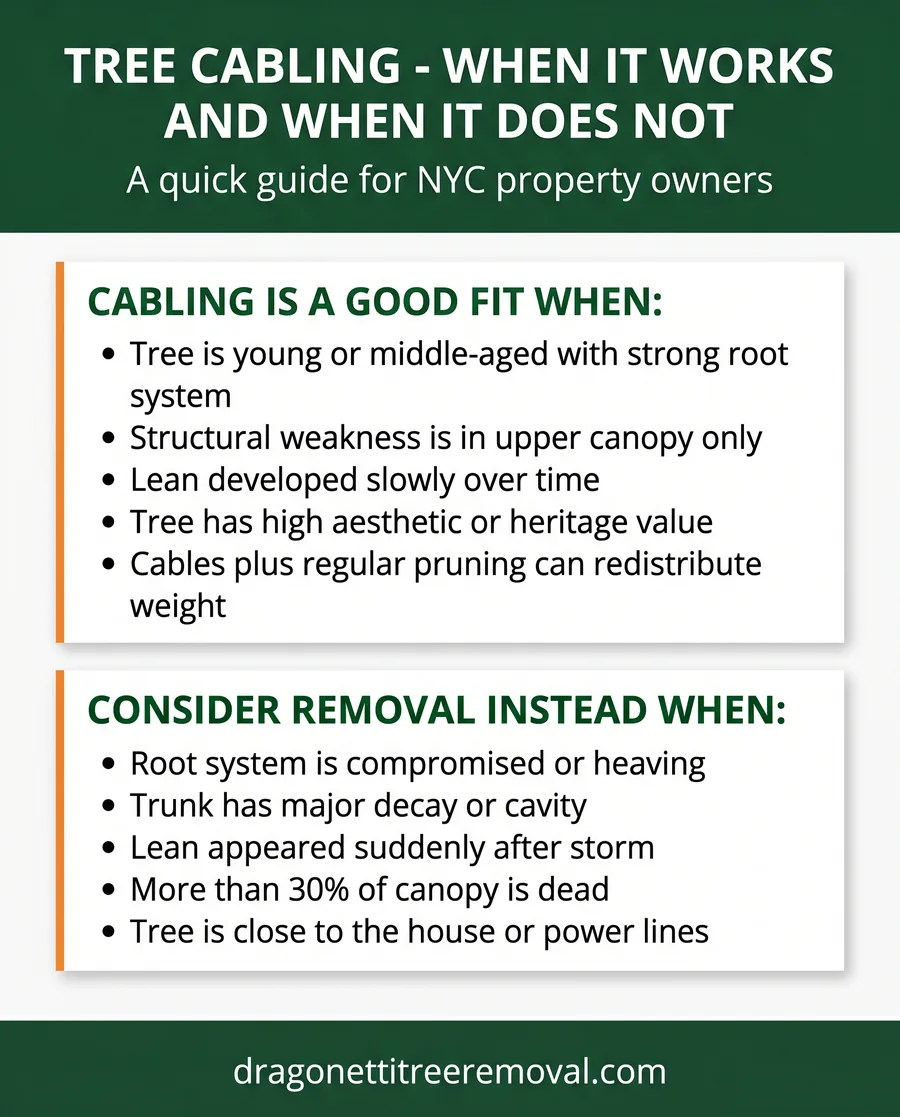
Tree cabling decision guide infographic showing when cabling works and when tree removal is the better option for NYC homeowners
Cabling can extend a tree’s life by decades – but only when the right conditions are present

People often ask

How long does tree cabling last? A properly installed static system should be inspected every one to two years and the hardware evaluated for corrosion every 10 to 15 years. Dynamic synthetic rope systems need inspection more often – every three to five years – since synthetic materials degrade faster than steel. As the tree grows, cable tension must be adjusted to avoid girdling the branch.

When Cabling Will Not Be Enough

An honest arborist will tell you when cabling is not the right answer. There are clear situations where cables cannot make a tree safe:

  • Root system heaving or visible soil movement around the base. This means the tree has already begun to uproot. No above-ground support system can fix a failing foundation.
  • Sudden lean after a storm. A tree that was straight last week and leaning today has suffered structural failure. This is a removal situation, not a cabling situation.
  • Significant trunk decay – hollow sections, large cavities, or extensive fungal growth on the trunk. Hardware installed in decayed wood will not hold.
  • More than 30% of the canopy is dead or dying. A tree in decline does not benefit from structural support.
  • The tree is within fall distance of occupied structures. When the consequence of failure is catastrophic, the risk threshold for cabling has to be very conservative.
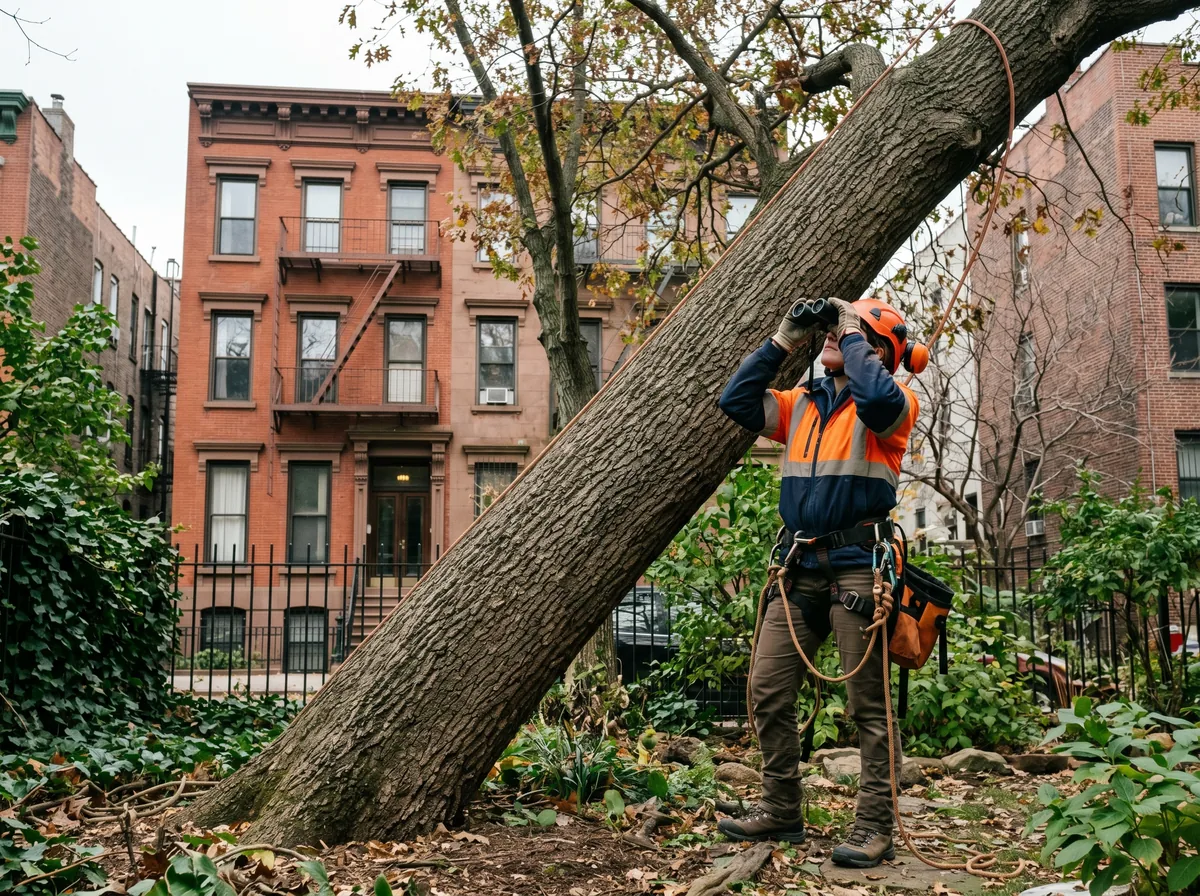
Certified arborist assessing a leaning tree in NYC residential backyard to determine if cabling is viable
A proper cabling assessment starts with a full structural evaluation by an ISA-certified arborist

Save your money

Cabling costs $300 to $1,500 for a straightforward single installation. Removal of a large NYC tree typically runs $2,000 to $8,000 or more, depending on access and crane requirements. If your arborist confirms the tree is structurally viable, cabling can save you thousands – and keep a tree you value standing for decades longer.

Cabling vs Removal – Making the Call

The decision between cabling and removal comes down to one core question: is the tree structurally viable, or has failure already begun?

A certified arborist assesses the root system, trunk condition, canopy health, and the specific nature of any lean or structural weakness. They will also consider where the tree sits relative to your house, utility lines, and occupied areas – because risk tolerance has to be lower when the consequences of failure are higher.

If cabling is recommended, ask the arborist to explain exactly what the cables are designed to do, what they cannot prevent, and what the inspection schedule looks like going forward. A cabling installation without ongoing monitoring is not a one-and-done solution. It is a management strategy that requires regular checkups to remain effective.

Dragonetti Tree Removal serves homeowners and property managers across Brooklyn, Queens, Manhattan, The Bronx, and Staten Island. Our licensed, insured arborists handle tree cabling, bracing, and removal from start to finish. Request a free estimate and get a written quote before any work begins.

Download the free guide

Download our quick reference covering cabling system types, signs a tree is a good candidate, and red flags that mean removal is the safer choice.

Tree Cabling Quick Guide – Free PDF

Frequently Asked Questions

What is tree cabling and how does it work?+

Tree cabling is a structural support technique where an arborist installs high-strength cables between major branches or from the trunk to an anchor point higher in the canopy. The cables are designed to limit how far branches can swing during storms and to redistribute weight away from weak union points. There are two main approaches: static cabling uses galvanized steel cables with threaded hardware installed directly into the branch wood, while dynamic cabling uses synthetic ropes or webbing that allow more natural movement. A related technique called bracing uses threaded rods installed through co-dominant stems to prevent the trunk from splitting at a V-shaped union.

Can tree cabling save a leaning tree?+

Sometimes, yes – but it depends entirely on why the tree is leaning and how severe the lean is. If the lean has developed slowly over years and the root system is intact and healthy, cabling combined with careful pruning to redistribute the canopy weight can be effective. What cabling cannot fix is a compromised root system. If the tree has started to uproot, if roots are visibly heaving the soil, or if the lean appeared suddenly after a storm, that suggests the foundation is already failing. At that point, no amount of cabling above ground will make the tree safe. An ISA-certified arborist needs to evaluate the roots before recommending cabling as a solution.

How much does tree cabling cost in NYC?+

Tree cabling in New York City typically costs between $300 and $1,500 for a straightforward single-cable installation on a residential tree. More complex jobs involving multiple cables, bracing rods, or large canopy trees with difficult access can run $1,500 to $3,000 or more. The price reflects the arborist’s assessment time, hardware and materials, the height and difficulty of the installation, and follow-up inspection scheduling. Compared to tree removal – which for a large NYC tree can run $2,000 to $8,000 or more – cabling is often the more economical choice when the tree is structurally viable. Get a written estimate that specifies what is included before agreeing to any work.

How long do tree cabling systems last?+

A properly installed static cable system using quality hardware typically lasts 10 to 15 years before the hardware should be inspected for corrosion and re-evaluated. Dynamic synthetic rope systems may need inspection and replacement every 3 to 5 years since synthetic materials degrade faster than steel. Regardless of system type, the cable installation should be inspected by a certified arborist every year or two. Trees grow, and cables that were correctly tensioned at installation can become too tight or too loose as the trunk diameter increases. A neglected cable system can actually cause damage by girdling the branch if not adjusted over time.

Does tree cabling work on all types of trees?+

Cabling works best on mature, structurally sound trees that have a specific weak point in the upper canopy. Trees with solid hardwood – oaks, maples, lindens – tend to hold hardware well and respond well to the reduced stress. Softer-wooded species and trees already in decline are less reliable candidates because the wood may not hold the anchor hardware securely over time. Dead wood, cavities, and advanced decay are disqualifying factors regardless of species. The tree’s overall health and the condition of its root system matter more than species alone. An arborist will assess all of these factors during the initial evaluation before recommending cabling.

What is the difference between tree cabling and tree bracing?+

Cabling and bracing are related techniques often used together. Cabling runs cables through the upper canopy to connect branches and reduce lateral movement. Bracing uses threaded steel rods drilled horizontally through co-dominant stems – two trunks growing from the same base – to keep them from splitting apart. Bracing rods address the union itself, while cables address movement above the union. On a tree with a V-shaped double trunk, an arborist might install a brace rod at the crotch and a cable several feet above it for comprehensive support. The two techniques complement each other and are frequently combined in a single treatment plan.

Do I need a permit for tree cabling work in NYC?+

For cabling work on trees located entirely on your private property, you generally do not need a permit from NYC Parks and Recreation. The permit requirement applies specifically to street trees – the trees in the sidewalk strip that are owned by the city – and to any work performed within 50 feet of a street tree. If the tree being cabled is a street tree or is close enough to one that the work could affect it, a Tree Work Permit from NYC Parks is required, and the contractor must hold ISA certification. Dragonetti handles the permit process for any work that requires one, so you will never have to navigate that paperwork on your own.

When should I choose tree removal over cabling?+

Removal is the safer choice when the tree poses an active risk that cabling cannot adequately reduce. The clearest indicators are a compromised root system – visible heaving, roots pulling out of the soil, or significant root zone damage from construction – and significant trunk decay or hollow sections. A tree that has suddenly developed a severe lean is also a removal candidate, not a cabling candidate, because sudden lean suggests structural failure has already begun. Trees within fall distance of the house, power lines, or occupied areas where failure would cause serious harm should be evaluated conservatively. When in doubt, get a second opinion from a certified arborist. A good arborist will tell you honestly when cabling is not the right answer.

The Bottom Line

Tree cabling works well when the tree is structurally sound below the problem area and the issue is limited to the upper canopy. It does not work when the root system is failing, the trunk has significant decay, or a sudden lean indicates the tree has already begun to fall. Get an ISA-certified arborist to assess your specific tree before deciding. If you are in NYC, we offer tree assessments and will give you a straight answer on whether cabling, bracing, pruning, or removal is the right call.

Marco D.

Written by

Marco D.

Tree-care operations writer & Tree care writer

Marco started climbing at 19 and has been a lead production climber for 15 years on NYC removal crews. He covers rigging large limbs over houses and power lines, aerial rescue practices, and the realities of brownstone backyard removals. He runs the climbing-only removals where crane access is impossible: Brooklyn brownstone backyards, Queens row-house gaps, and tree-lined Staten Island streets too narrow for equipment.