
In this article
Yes, in a lot of cases a tree can grow back from a stump, and that surprises homeowners who thought cutting it down was the end of the job. Many common New York trees push out fresh sprouts within weeks of being felled, and if you ignore them you can end up paying twice. The reliable way to close the door on regrowth is full stump and root grinding, but it helps to understand what is actually happening below the cut first.
A stump is not a dead piece of wood the moment the trunk comes off. The roots are still alive, still full of stored energy, and many species are wired to treat a sudden loss of the crown as a signal to regrow. Whether your stump stays quiet or turns into a cluster of shoots depends almost entirely on what kind of tree it was.
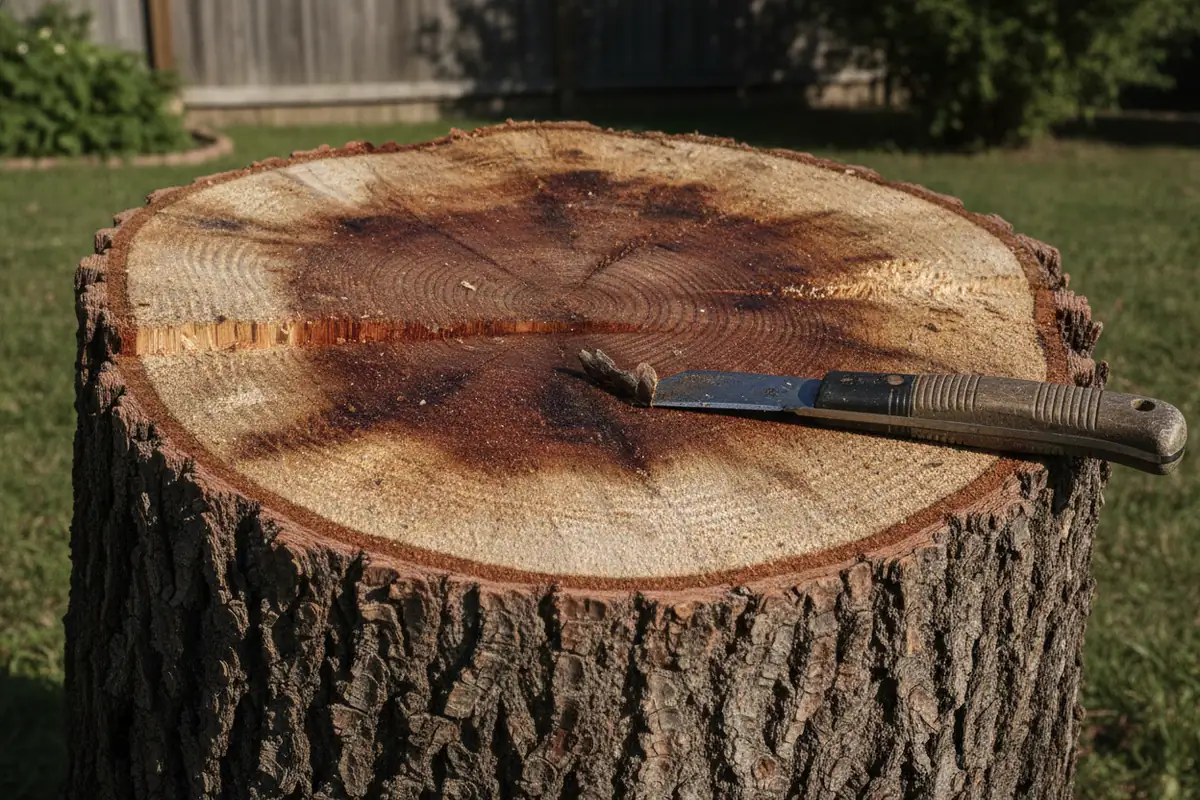
Why a Cut Stump Sprouts Again
When a tree is healthy, the crown and the roots stay in rough balance. The leaves feed the roots, and the roots feed the leaves. Cut the trunk and you remove the entire top of that system in an afternoon, but the root mass underground is untouched. It is still holding a large reserve of stored sugars, and it still has water moving into it.
Most broadleaf trees carry dormant buds under the bark and at the base of the trunk. Those buds sit idle for the life of the tree because hormones from the active crown keep them switched off. Remove the crown and that suppression disappears. Within days the roots redirect their stored energy into whatever growing points are left, and you get a flush of new shoots straight off the stump or out of the ground nearby. Arborists call those root suckers, and a single stump can throw a dozen of them.
Did you know?
A large stump can keep feeding new sprouts for two to three years on stored root energy alone. The shoots look weak at first, but if even one survives it can rebuild a full canopy and you are back where you started.
That is the part people miss. The sprouts are not the tree trying to heal a wound. They are the tree starting over, and the bigger the root system you left behind, the more fuel it has to do it.
Which Trees Grow Back, and Which Do Not
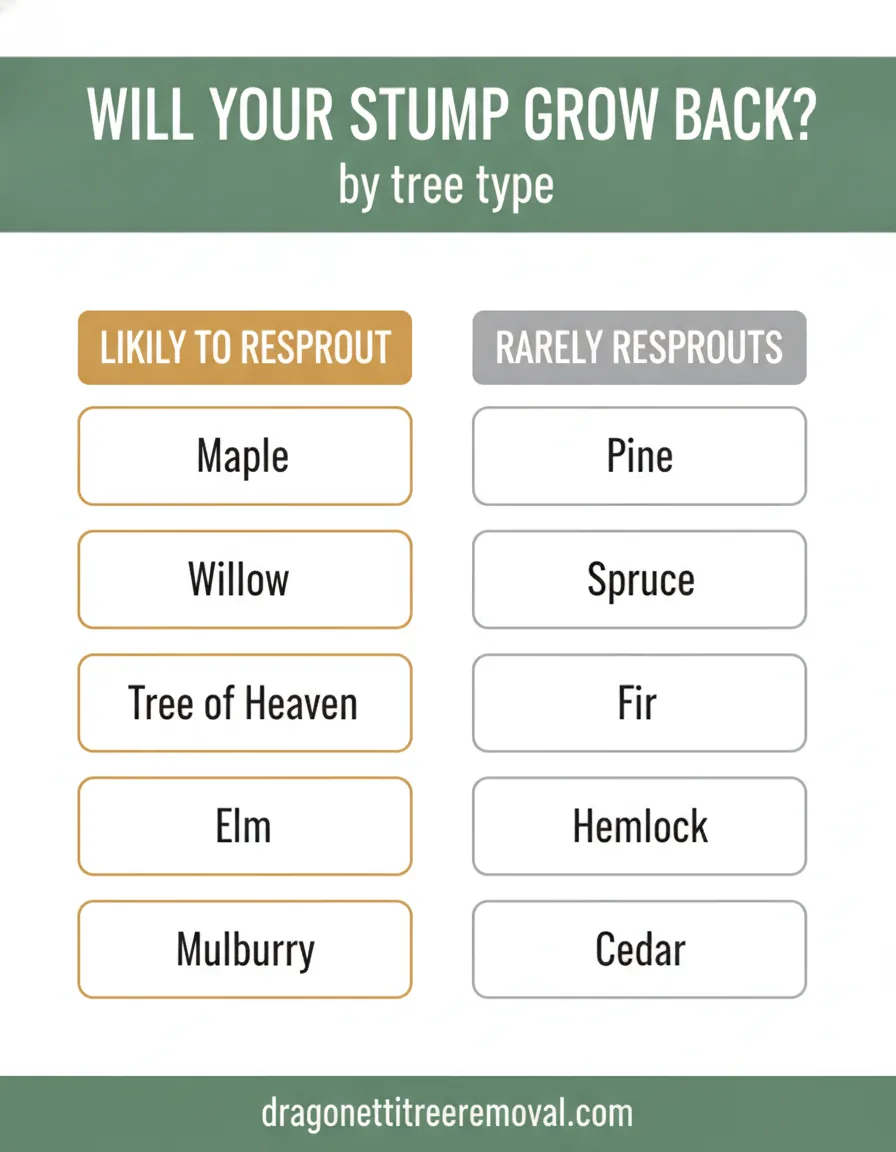
This is the single biggest factor, and it splits cleanly along one line: most broadleaf (deciduous) trees resprout, and most conifers (needled evergreens) do not. If you cut a pine, spruce, or most other cone-bearing trees down to a stump, it almost never comes back, because those species have no latent buds to call on. Cut a maple or a poplar and you should expect a fight.
| Strong resprouters (expect regrowth) | Rarely resprout (usually stay dead) |
|---|---|
| Norway and silver maple | Eastern white pine |
| Tree of heaven (Ailanthus) | Norway and blue spruce |
| Poplar and cottonwood | Most firs |
| Willow | Eastern hemlock |
| Black locust, elm, mulberry | Most cedars and junipers |
Tree of heaven deserves its own warning. It is one of the most aggressive resprouters in the five boroughs, it sends up suckers many feet from the original stump, and cutting it without removing the roots usually makes the problem worse. If that is what you took down, plan for root removal from the start.
People often ask: do I really need to grind the stump if the tree was a conifer?
Not always. If you removed a pine or spruce and you are fine with the stump sitting there, it will rot in place over several years without sprouting. The reasons to grind a conifer stump are cosmetic, tripping and mowing hazards, and clearing space to replant, not regrowth. With most maples and poplars, grinding is about actually stopping the tree from returning.
What Regrowth Does to a NYC Property
On a tight city lot, a resprouting stump is more than an eyesore. Root suckers from species like Ailanthus and silver maple chase the easiest path, which is often the gap under a sidewalk slab, the seam along a foundation, or a sewer lateral. Once roots widen those gaps you are looking at lifted flags, cracked parging, and the kind of repair that costs far more than the grinding would have.
There is a property-line dimension too. New growth does not respect a fence. Suckers that cross into a neighbor’s yard, or roots that travel under a shared walk, are how a simple removal turns into a dispute. We cover the legal side of that in our guide to who pays when a neighbor’s tree roots damage a foundation, and it is worth reading before regrowth gets that far.
Permits matter as well. Street trees and many large trees in New York are protected, and removal or major work can require approval. If you are unsure whether your tree is regulated, the city explains the rules through the NYC Parks tree work permit program. A stump that resprouts into a sizable tree can pull you back into that permitting process years later.
How to Tell if Your Stump is Still Alive
Before you decide what to do, confirm whether the stump still has a pulse. A live stump and a dead one call for very different responses, and the check takes five minutes.
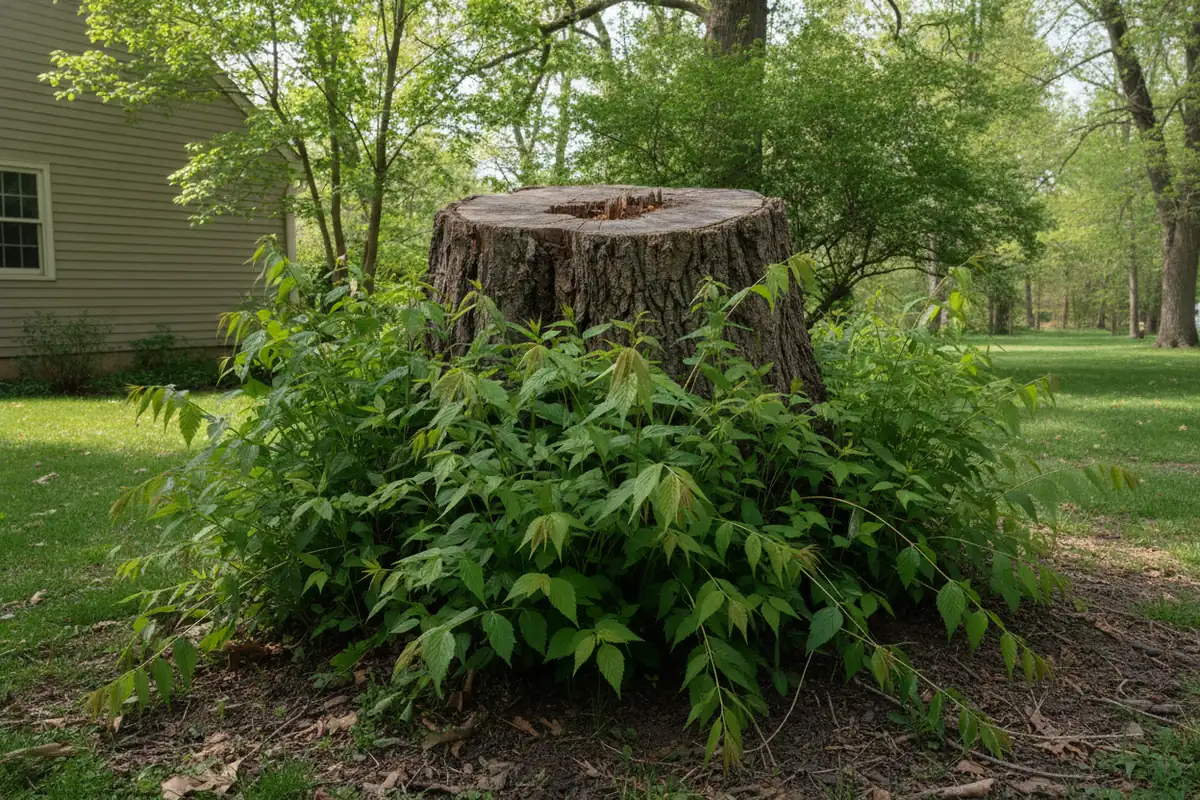
- Look for shoots. Green sprouts coming off the stump or the ground within a few feet are the clearest sign the roots are still active and feeding.
- Scratch the bark. Use a knife to nick the outer bark near the cut. Green and damp underneath means living tissue. Brown and dry all the way around usually means the stump is shutting down.
- Check the cut face. Fresh sap, a faint sweet smell, or new callus rolling over the edge all point to a stump that is still alive and trying to recover.
- Watch the timeline. A stump that shows nothing for a full growing season, April through October in New York, is very likely done. Conifers reach that point much faster than maples.
Pro tip
Do the scratch test in more than one spot. A stump can be dead on one side and alive on the other, especially on a wide trunk where part of the root system was damaged during removal. One green patch is enough to send up a new leader.
Grind it Out or Let it Go?
If the tree was a strong resprouter and you want the regrowth to stop for good, grinding is the honest answer. Cutting the shoots off by hand or hitting them with a string trimmer feels like progress, but it just prunes the stump and prompts it to push even harder. Repeated cutting can drag on for years, and the root energy almost always outlasts your patience.
Grinding removes the stump and the main root collar below grade, which takes away the growing points the tree needs. For aggressive species we go a little deeper and chase the surface roots, because leaving them is what lets suckers reappear. If you want the full method, our walkthrough on how to stop a tree stump from sprouting and growing back lays it out step by step.
There are cases where leaving the stump is reasonable: a dead conifer in a back corner, a stump you plan to let rot naturally, or a spot where access for a grinder is genuinely impossible. For anything near a walk, a foundation, or a fence line, removal is the call. When in doubt, a quick look from an arborist across our Queens tree care service area will tell you whether the roots are still a threat.
Frequently asked questions
How long does it take for a tree to grow back from a stump?
Sprouts usually appear within two to six weeks of the tree being cut, during the growing season. Those first shoots grow fast because they draw on stored root energy rather than starting from a seed. Within one to two years a vigorous resprouter like silver maple or tree of heaven can rebuild a small canopy several feet tall. The only way to be sure it has stopped for good is to remove the stump and main roots, since a living root system can keep trying for two to three years.
Will bleach or salt kill a stump and stop it growing back?
Home remedies like bleach, rock salt, or motor oil are unreliable and can harm the surrounding soil, nearby plants, and groundwater. Salt in particular lingers and can damage anything you try to plant in that spot later, which is a real problem on a small city lot. They also tend to kill the visible top while leaving roots alive enough to sprout again. Mechanical grinding is faster, cleaner, and does not contaminate the area you may want to replant.
Can I just keep cutting the new shoots off?
You can, but it rarely ends the problem. Each time you cut the sprouts you are pruning the stump, and a pruned stump often responds by pushing out even more shoots from its stored energy. People who go this route usually find themselves trimming the same stump for several seasons. Removing the stump and root collar takes away the growing points entirely, which is why grinding settles it in one visit.
Do conifer stumps like pine and spruce grow back?
Almost never. Pines, spruces, firs, and most needled evergreens do not carry the dormant buds that let broadleaf trees resprout, so once the trunk is removed the stump simply declines and rots in place. If you took down a conifer, regrowth is not the concern. You would only grind that stump for appearance, to remove a tripping or mowing hazard, or to clear room to replant.
Not sure if your stump is done sprouting?
Here is the short version: confirm the species, check for live tissue, and if it is a maple, poplar, or tree of heaven, plan on grinding the roots out. Dragonetti handles stump grinding and root removal across Brooklyn, Queens, the Bronx, Manhattan, and Staten Island.
Request a free stump removal quote