In This Article
You’ve probably walked past them thousands of times without knowing. The fast-growing tree cracking through the fence in the empty lot on Flatbush Avenue. The giant-leafed thing taking over the backyard on the edge of Marine Park. The tree with the purple flowers everyone thinks is beautiful until it’s everywhere. Brooklyn and Queens are full of invasive tree species, and most homeowners have no idea which ones are on their property, or why it matters. Our team identifies and removes these species all over the five boroughs. Here is what you actually need to know.
What Makes a Tree Invasive in the First Place
An invasive tree is not just a tree someone planted in the wrong place. Invasive species are non-native plants that spread aggressively, outcompete native trees and plants for sunlight and resources, and cause measurable ecological or structural damage. In NYC, that damage shows up as cracked sidewalks, damaged foundations, overwhelmed drainage systems, and the slow disappearance of native tree canopy that supports local wildlife and storm water management.
New York State classifies several tree species as invasive under the New York State Department of Environmental Conservation guidelines. Planting or selling listed invasive species is regulated. But tens of thousands of these trees are already established across Brooklyn, Queens, Staten Island, and the Bronx, growing without anyone’s permission on private property, vacant lots, and fence lines.
Tree of Heaven: The Fast-Growing Problem Tree
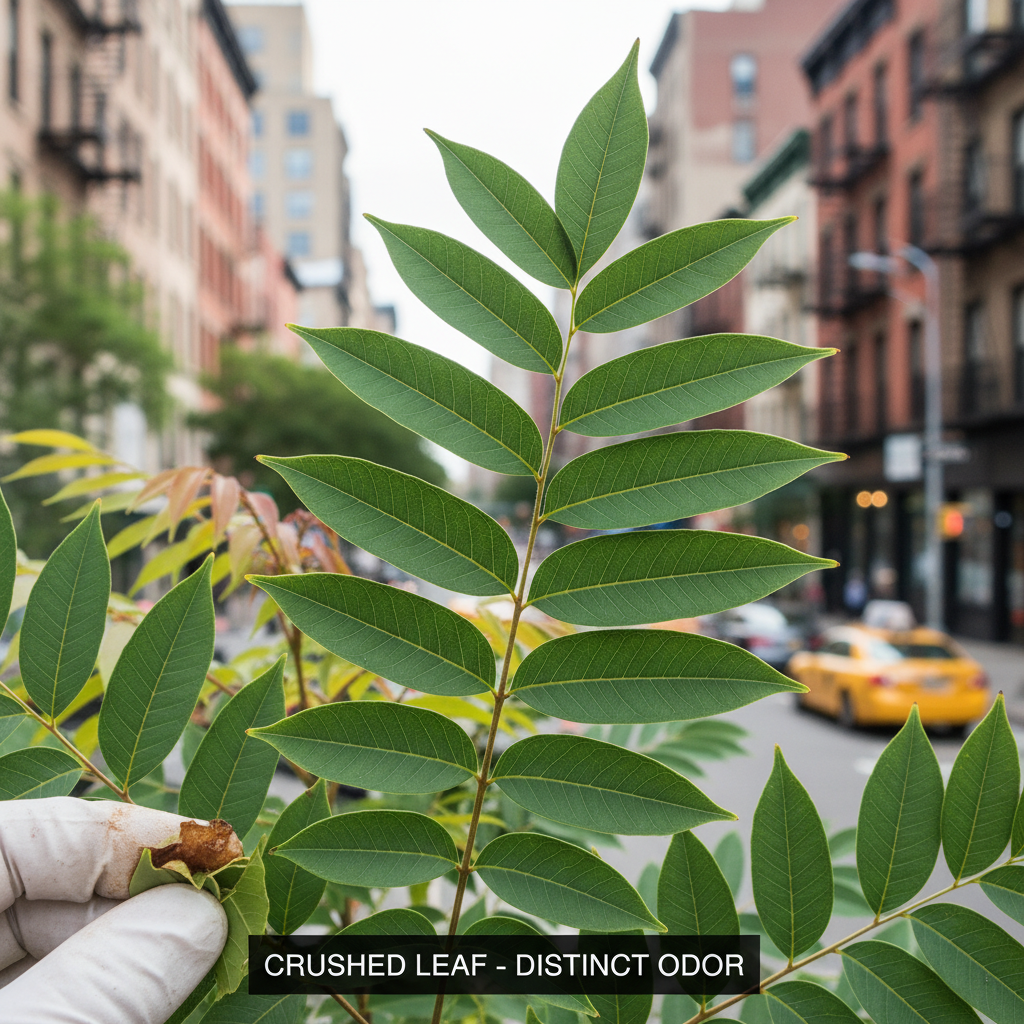
The tree of heaven (Ailanthus altissima) might be the most problematic invasive species in NYC. It grows up to six feet per year. Each female tree produces up to 300,000 seeds annually. It tolerates pollution, compacted soil, drought, and every other urban stressor that kills native trees. And it does something no other tree does quite as effectively: it establishes itself in the cracks of walls, fence posts, basement windows, and drainage systems, and grows until something structural gives.
How to identify it:
- Compound leaves with 11 to 41 leaflets, each with smooth, untoothed edges
- Crush the leaf: it smells like rancid peanut butter. That is the fastest test.
- Seeds hang in large clusters of reddish-brown winged samaras (helicopter seeds)
- Young twigs are velvety, reddish-brown, and break easily to reveal a spongy center
- Bark is smooth and grey, developing shallow furrows as the tree matures
The identification matters because of what happens when you try to remove it incorrectly. Cut a tree of heaven and leave the stump? Within weeks you will have dozens of shoots sprouting from the root system. The Penn State Extension has documented this resprouting response extensively: the tree reacts to cutting by going into survival mode and sending up root suckers aggressively. Proper removal requires either full stump grinding or a targeted herbicide treatment on the cut surface, applied within minutes of cutting. This is not a DIY job for a tree that has established root infiltration near your foundation.
Norway Maple: The Sidewalk and Lawn Destroyer
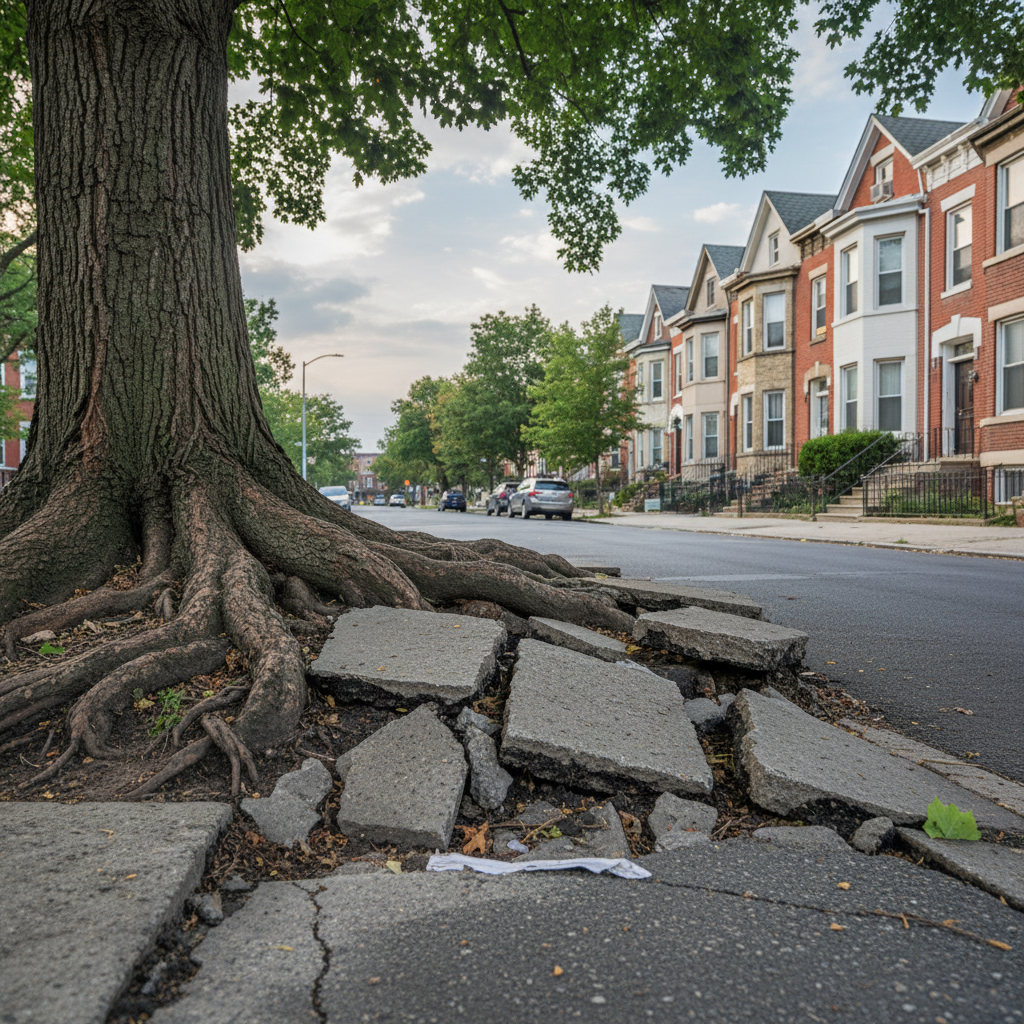
Norway maple (Acer platanoides) was planted all over NYC as a street tree for decades, specifically because it tolerates urban conditions so well. The problem is that it tolerates them too well. It spreads aggressively into parks and natural areas, and its dense canopy and shallow root system cause two specific problems for homeowners: it kills everything under it and it lifts your sidewalk and driveway.
Identifying Norway maple vs. native sugar maple is straightforward with one field test. Break the leaf stem off. If a milky white sap immediately appears at the break, you have a Norway maple. Sugar maple sap is clear. That one test works every time.
Other identification markers:
- Star-shaped leaf with five to seven pointed lobes, similar to a sugar maple but slightly glossier
- Seeds (paired samaras) spread nearly horizontally, almost 180 degrees apart
- Dense shade canopy: nothing grows underneath it, including grass
- Very common as an existing street tree in Bay Ridge, Flatbush, Flushing, and Astoria
The shallow root system is the structural hazard. Norway maple roots run wide and close to the surface, and in a city of concrete sidewalks and asphalt driveways, the result is predictable: cracked pavement, lifted slabs, and liability for the property owner. According to NYC 311 tree complaint data, sidewalk damage from street trees is one of the most common tree-related property complaints in the city.
Princess Tree: Pretty but Prolific
The princess tree (Paulownia tomentosa) gets more tolerance than it deserves because it is genuinely beautiful in spring. The purple tubular flowers appear before the leaves, covering the tree completely, and people love it. Then the leaves emerge and you realize what you have: a tree with leaves up to two feet wide, capable of producing 20 million seeds per year, and establishing itself on rooftops, abandoned lots, and disturbed soil across every borough.
How to identify it:
- Enormous heart-shaped leaves, sometimes 24 inches across on young trees
- Dramatic purple tubular flowers in early spring before leaves emerge
- Brown seed pods that look like small wooden eggs persist through winter
- Smooth grey-brown bark, branches with a distinctive opposite branching pattern
- Fast growth (up to 15 feet in the first year from stump regrowth)
Like tree of heaven, princess tree resprouts aggressively from cut stumps. In abandoned lots and disturbed areas in Bushwick, Ridgewood, and Jamaica, it is a common sight growing in improbable places: through chain-link fences, from roof gutters, and between building footings.
What to Do If You Have One
Start with a proper identification. The milky sap test works for Norway maple. The smell test works for tree of heaven. For princess tree, the flower timing and leaf size are usually enough. If you are not sure, reach out and we can assess it, particularly if the tree is close to your foundation, fence, or drainage infrastructure.
A few things to know before you do anything:
NYC may require a permit. Even for invasive species, trees on private property that are above a certain size, or located near a street, may require a removal permit from NYC DPR. Our tree permit services team handles this regularly. The permit process is straightforward but it takes time, so do not wait until the tree is causing active damage.
Cutting without treating the stump is worse than leaving it. For tree of heaven especially, cutting the tree and leaving the stump will trigger a root-sprouting response that is far harder to manage than the original tree. If you hire someone to simply cut it down without addressing the stump, you are creating a future problem, not solving one.
Timing matters for treatment. The most effective window for herbicide treatment of tree of heaven stumps is late summer to early fall, when the tree is moving carbohydrates to its roots and will carry the treatment downward. Treating in spring, when sap is moving upward, is far less effective. Penn State Extension’s tree of heaven control strategies guide covers this in detail.
Document before you start. Take photos of the tree, its location relative to your structures, and any visible damage it is causing. This documentation matters if you need to make an insurance claim for damage already caused, or if you encounter a permit dispute with NYC.
We work across Brooklyn, Queens, Staten Island, and the Bronx on invasive tree identification and proper tree removal. If you have a tree of heaven growing into your foundation, a Norway maple lifting your driveway, or any other invasive species situation, request a quote and we will assess it.
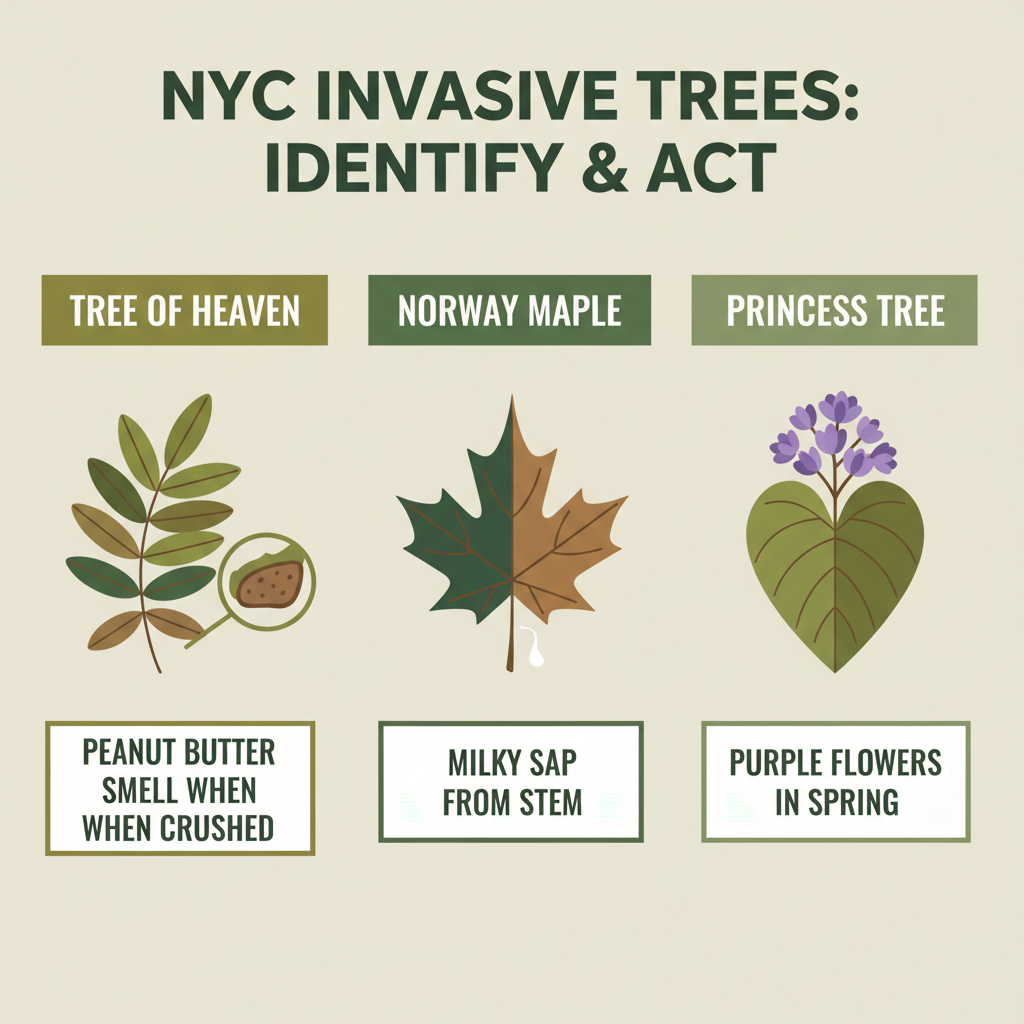
Download: NYC Invasive Tree Field Guide (PDF)
Identification features for tree of heaven, Norway maple, and princess tree, plus what to do if you find one on your property.
Download PDF GuideFrequently Asked Questions
Is tree of heaven the same as ailanthus?
Yes. Tree of heaven’s scientific name is Ailanthus altissima. In NYC, especially in older Brooklyn and Queens neighborhoods, residents often call it “ailanthus” or “stink tree.” It is the same plant, classified as invasive by New York State.
Do I need a permit to remove an invasive tree from my property in NYC?
It depends on the tree’s location and size. Trees within 50 feet of a NYC street, or trees planted in the sidewalk strip, typically require a DPR permit regardless of species. Trees entirely on private property and away from the street may not require one. We handle permit applications regularly and can advise based on your specific situation.
Why does tree of heaven smell so bad?
The odor comes from compounds called ailanthone and saponins in the leaves, bark, and roots. The smell is strongest when the leaves or bark are crushed or broken. It has been described variously as rancid peanut butter, cat urine, or burnt rubber. The smell is one of the fastest identification methods.
Can Norway maple damage my foundation?
Less commonly than tree of heaven, but yes, under the right conditions. Norway maple’s shallow root system causes more frequent problems with sidewalks, driveways, and surface drainage than with building foundations. Tree of heaven’s more aggressive root system is the greater foundation risk of the two.
Why do invasive trees spread so fast in NYC?
Urban environments favor them. Invasive trees like tree of heaven and Norway maple evolved in conditions with strong competition from other plants. In NYC, disturbed sites, poor soil, air pollution, and compacted ground eliminate most of that competition, giving invasives an open field. Their high seed production does the rest.
Invasive Tree on Your Property?
We identify and remove invasive trees across Brooklyn, Queens, Staten Island, and the Bronx. Get a professional assessment before it gets worse.
Request a Free Assessment