
The first sign is almost never a smell. It’s a bathtub that drains a little slower every week, or a toilet that gurgles right when the washing machine empties. On blocks with big old street trees, tree roots in sewer lines are one of the most common reasons a house starts backing up for no obvious reason, and the pattern usually builds for months before anyone calls anyone. If you have already noticed a nearby sidewalk pushed up by a root, the same root system may be working underground toward your pipes at the same time.
Sewer laterals are not sealed the way people assume. Older clay and cast iron pipe sections have joints, hairline cracks, and small offsets that let a trace of moisture and warmth escape into the surrounding soil. A tree root does not need a hole to find that, it needs a seam. Here is how tree roots get into sewer lines, the signs worth checking before the problem gets loud, and where a homeowner’s part ends and NYC DEP or a licensed plumber’s part begins.
How tree roots find their way into a sewer line
A sewer lateral carrying wastewater is warm, slightly moist, and full of dissolved nutrients compared with the surrounding soil, and roots are extremely good at sensing exactly that combination. They do not push through solid pipe wall. A fine root tip finds an existing seam, a joint that has shifted slightly, or a hairline crack from ground settling, and grows through it because conditions on the other side are better than anywhere else nearby.
Once a single root gets a foothold inside the pipe, it thickens over seasons the same way any root would, and it starts catching toilet paper, grease, and debris the way a net catches leaves in a stream. That combination, root plus trapped debris, is usually what turns a small intrusion into a full clog rather than the root itself blocking the line on its own.
Warning signs tree roots are already inside
None of these signs on their own proves what is happening underground, but together they build a pretty clear picture, especially if your home is on a block with mature trees and an older sewer connection.
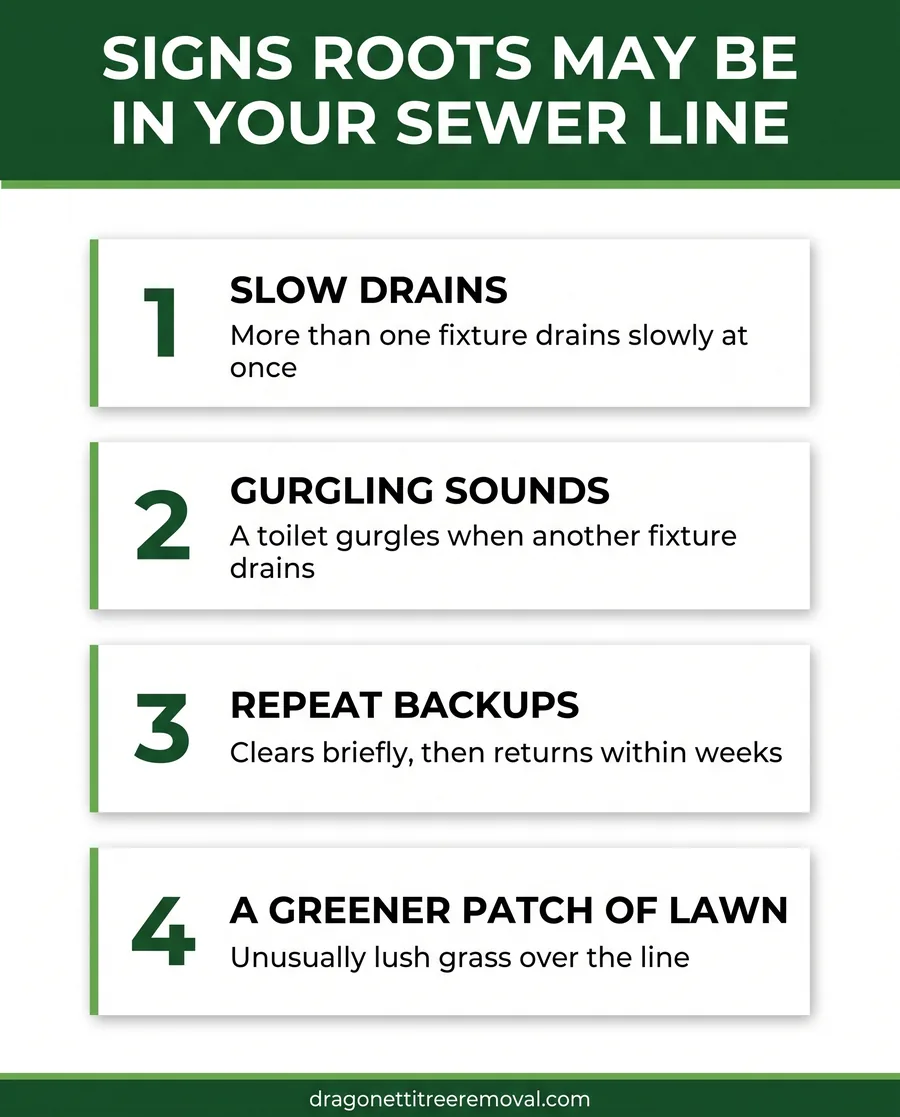
- Slow drains in more than one fixture at once, especially the lowest drain in the house, which is usually the first to react to a partial blockage further down the line.
- Gurgling from a toilet or floor drain when another fixture, like a washing machine, is draining at the same time.
- Backups that come back within weeks of a snake or a plunger clearing them, instead of staying clear for months.
- A patch of unusually green, fast growing grass over the lateral line, since leaking wastewater acts as fertilizer.
- A faint sewage smell in the yard after it rains, when groundwater pushes gases up through a compromised section of pipe.
Red flag
Sewage backing up into a tub, floor drain, or basement fixture is not a wait and see situation. Stop using water in the house, avoid contact with the backed up water, and call a licensed plumber the same day. That is a health and property issue first, and a root diagnosis second.
Which trees and pipe types make this more likely
The trees most often blamed for tree roots in sewer lines are fast growing, water seeking species like willow, poplar, and silver maple, though almost any mature tree can send roots toward a leaking pipe if the conditions are right. Distance matters less than people expect. Roots regularly travel well beyond the width of the canopy in search of water, so a tree on the far side of a yard is not automatically out of reach of a lateral running under the house.
Pipe material and age matter just as much as the tree. Older clay and cast iron laterals, common across many NYC blocks, have more joints and are more prone to the small cracks roots exploit than a newer, continuous plastic line. A property with an older lateral and a mature street tree nearby has both risk factors at once, which is exactly the combination worth a proactive look rather than waiting for a backup.
Pro tip
If your home backs up more than once in a year or two, ask whoever clears it to run a camera through the line before you call it fixed. A snake clears the immediate clog. A camera shows whether roots, a cracked joint, or a low spot in the pipe is the actual cause, which changes what a lasting fix looks like.
What to do if you suspect root intrusion
Start with NYC DEP’s water and sewer service line guidance, which walks through how water and sewer service lines are handled in New York City and where to find help if a line running to your property needs attention. A licensed plumber can then run a camera to confirm tree roots in a sewer line are actually the cause and how far along the pipe they have spread, which is information worth having before agreeing to any particular fix.
On the tree side, an arborist can tell you whether the tree feeding the roots is healthy, declining, or a stump that is still sending out new growth. Sometimes grinding out an old stump properly is what actually stops root regrowth toward a pipe, rather than only treating the plumbing side of the problem. If the tree itself is the issue and it needs to come down, a risk assessment visit is the right starting point before anything is scheduled.
Good to know
This article explains a common cause of sewer backups in general terms. It is not a diagnosis of your property, and it does not address who is responsible for repairing any particular section of pipe, which depends on where the problem sits and your specific service line. Confirm those details with NYC DEP and a licensed plumber, and check your homeowner’s policy directly with your insurer for what it does and does not cover.
Download the free quick guide
A printable one-page guide: the early signs to watch for, what questions to ask a plumber, and how a tree assessment fits into the picture.
Frequently asked questions
Can tree roots actually break through a solid, undamaged pipe?
Not usually. Roots are opportunistic rather than destructive on their own, and they tend to enter through an existing joint, hairline crack, or small offset rather than pushing through solid pipe wall. That said, once a root is established inside a line, it keeps growing and can widen the original opening or shift a joint further out of alignment over time, which is why an early intrusion rarely stays small if it is left alone.
How can I tell if slow drains are roots and not something else?
Slow drains have several common causes, including grease buildup, a collapsed section of pipe, or simple age. What points more toward roots is a pattern that affects the lowest fixtures first, comes back within weeks of being cleared, and shows up on a block with mature trees and an older sewer connection. A camera inspection by a licensed plumber is the most reliable way to confirm it rather than guessing from symptoms alone.
Will removing the tree fix a sewer line that already has roots in it?
Removing the tree can stop new roots from reaching the pipe, but it does not clear existing tree roots in a sewer line, and a stump left in the ground can keep sending out roots for a while afterward. Most cases end up needing both a plumbing fix for the existing intrusion and, where the tree or stump is the ongoing source, a separate conversation about removing or grinding it.
Does homeowners insurance cover a sewer line damaged by tree roots?
This depends entirely on your specific policy and how your insurer classifies gradual damage versus a sudden event, and it is not something we can answer in general terms. Check your policy wording directly and ask your insurer how they handle root related sewer damage before assuming either way, since coverage varies a lot between carriers and even between individual policies.
How often should an older sewer line near mature trees be checked?
There is no single interval that fits every property, since it depends on the age and material of your line, how close the nearest large tree sits, and whether you have had a backup before. Many plumbers suggest a camera check every couple of years for older clay or cast iron laterals near mature trees, simply because it catches a developing problem while it is still a maintenance job rather than an emergency one.
If you are seeing any of the signs of tree roots in sewer lines above, here is a reasonable order to work through them in:
- Write down which fixtures are affected and how often the problem repeats, since that pattern is useful information for whoever inspects the line.
- Call a licensed plumber for a camera inspection before assuming a snake or plunger has actually solved anything.
- If a specific tree or stump looks like the source, have it looked at separately so the root cause, not just the symptom, gets addressed.
Dragonetti Tree Removal handles the tree side of this across Brooklyn, across Queens neighborhoods, and the Bronx. If an aging tree or a stubborn stump near your sewer line needs a professional look, request a quote from our tree crew and we can tell you what we are seeing from above ground.