Table of contents
- The legal standard New York actually applies
- What turns a dying tree into a legal liability
- What your neighbor can actually do about your tree
- How to document removal to protect yourself
- Cost vs liability: doing the math
- What to do if you already received a complaint
- Frequently asked questions
- Get a written hazard assessment before the next storm
Most NYC homeowners think a dying tree in their backyard is their own problem until it falls. It is not. The minute a reasonable person could have noticed that tree was dangerous, you have a legal duty to do something about it, and what happens after that determines whether your neighbor’s homeowners insurance pays for the damage or whether you do. Here is how dead tree liability actually works in New York in 2026, what triggers the duty, and how to document a tree removal correctly so you are protected if something goes wrong.
The Legal Standard in New York
New York is what lawyers call a “modified” or “reasonable care” jurisdiction for tree liability. The general rule comes from a 1976 Court of Appeals decision (Ivancic v. Olmstead) and the cases that followed it: a property owner is liable for damage caused by a falling tree only if they knew or should have known that the tree was in dangerous condition and failed to take reasonable steps to prevent the damage.
That sounds vague. In practice, courts look at three things:
- Visible signs of decay or disease. Dead branches, large cavities, mushroom or conk growth at the base, peeling bark, hollow trunks. These are visible to a non-expert and create constructive notice — meaning a court will say you “should have known.”
- Prior notice. Did a neighbor, the city, or an arborist tell you the tree was dangerous? Was there a 311 complaint or a written hazard report on file? Documented notice closes the “should have known” loophole instantly.
- Whether you took reasonable action. Hiring a certified arborist for assessment, getting a written report, scheduling removal, and documenting that work in progress are all evidence that you acted reasonably even if the tree fell before the work was done.
What Turns a Dying Tree into a Legal Liability
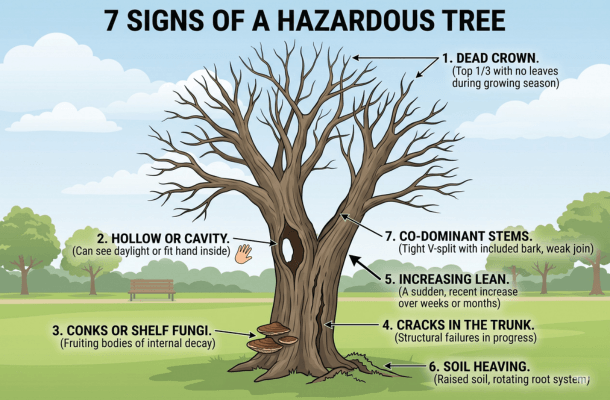
From the perspective of a Tree Risk Assessment Qualified arborist, the standard signs that put a NYC homeowner on notice are:
- Dead crown. More than a third of the canopy with no leaves during growing season is a serious red flag.
- Hollow or cavity in the main trunk. Especially if you can see daylight through it or fit your hand inside.
- Conks or shelf fungi at the base or on the trunk. These are the visible fruiting bodies of decay fungi already inside the wood.
- Cracks in the main trunk. Vertical cracks more than a few feet long are structural failures in progress.
- Lean that increased recently. A tree that has always leaned slightly is usually fine. A tree that suddenly increased its lean over weeks or months is failing at the root plate.
- Soil heaving around the root flare. Lifted soil on the side opposite a lean indicates the root system is rotating in the ground.
- Co-dominant stems with included bark. Two trunks splitting from a tight V are structurally weak and prone to failure in wind.
If any of those signs are visible from your driveway or your neighbor’s yard, you are on constructive notice. The clock starts.
What Your Neighbor Can Actually Do About Your Tree
This is the question NYC property owners ask most often. The short answer: more than you think. In New York, if your tree is creating a documented hazard and you ignore it, your neighbor has several legal options:
- Self-help to the property line. They can prune any branches that overhang their property, at their own expense, as long as the work does not damage the tree as a whole. They cannot enter your property to do it. The roots that cross under their lawn fall under the same rule.
- Demand letter and 311 complaint. A written notice from a neighbor (especially with photos and an arborist’s opinion) is documented evidence of “actual notice.” Once you receive that letter, you cannot claim you did not know.
- NYC Department of Buildings or 311 nuisance complaint. The city does inspect private hazard trees in some cases, particularly when they threaten public sidewalks or streets. NYC 311 tree emergency reporting explains the reporting process. DOB can issue violations.
- Civil lawsuit before damage occurs. A neighbor can sue for an injunction requiring you to remove a documented hazard tree. These suits are rare but they happen, and the documentation cost shifts to the homeowner who failed to act.
- Civil lawsuit after damage occurs. If the tree falls and damages their property, and they can show you had notice (from any of the above), their carrier subrogates against your homeowner’s policy and you pay the deductible plus any uninsured shortfall.
How to Document Removal to Protect Yourself
If you have a tree that meets any of the warning signs above, the protection strategy is paper. Specifically:
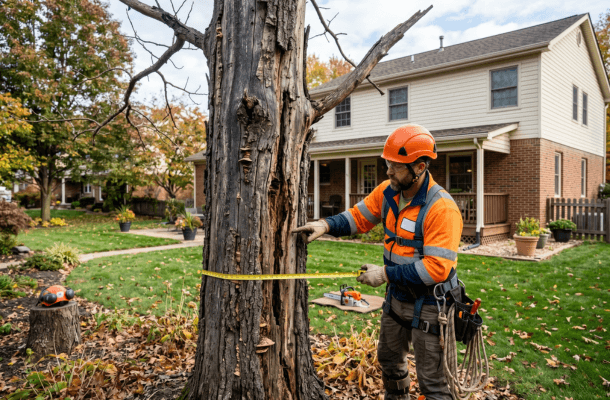
- Get a written hazard report from an ISA Certified Arborist with the Tree Risk Assessment Qualification (TRAQ). The report should describe the tree, the visible defects, the assessed risk rating (Low, Moderate, High, or Extreme under the ISA Best Management Practices), and the recommended action. This is the document that proves you took the situation seriously the moment you noticed it.
- Save dated photos. Wide shots and close shots of every defect. Geotag if possible. These become evidence later.
- Schedule the removal as soon as the report is in hand. If the tree is rated High or Extreme risk, “as soon as practical” means days, not months. If the rated risk is Moderate, weeks are usually defensible.
- Keep the contract, the invoice, the certificate of insurance, and the work-completion photos. The whole paper trail goes in a folder. If a neighbor ever challenges you, this is your defense.
- If the tree is on a property line, talk to your neighbor first. Boundary trees in New York are co-owned by both property owners. Removing one without consent can expose you to a separate lawsuit for damage to a co-owned asset.
Cost vs Liability: Doing the Math
NYC homeowners often delay removal because removing a mature hazard tree is expensive (typically $2,500 to $15,000 depending on size, access, and crane requirements). Compare that to what a typical claim looks like when a tree falls:
- Damaged neighbor’s car: $5,000 to $40,000 (your liability, not your auto insurance)
- Damaged neighbor’s house: $25,000 to $250,000+ for structural damage
- Personal injury to a neighbor or passerby: $100,000 to $1M+ (medical, lost wages, pain and suffering)
- Wrongful death: seven figures, plus criminal exposure for gross negligence
The math is not subtle. A $5,000 removal that you delay for three years can become a $400,000 lawsuit. The standard homeowners liability cap of $300,000 to $500,000 will not always cover it, and any shortfall comes out of personal assets.
What to do if you Already Received a Complaint
If a neighbor or the city has already notified you in writing that your tree is dangerous, the response window is short. Specifically:
- Within 7 days: Hire a TRAQ-certified arborist to assess the tree in person. Get the written report.
- Within 14 days: If the report rates the tree High or Extreme risk, schedule removal. Notify the complaining party in writing that the work is scheduled and provide the date.
- Within 30 days: Removal completed (faster if the risk rating is Extreme). Send a final notice with photos of the cleared site.
Acting in this timeframe makes you legally defensible. Ignoring the complaint, by contrast, is the single worst thing you can do. Documented notice plus inaction equals negligence per se in front of a New York judge.
FAQs
Can my neighbor force me to remove my tree?
Only if it is in documented dangerous condition or actively damaging their property. A healthy tree, even one that drops leaves and acorns into their yard, cannot be forced down. New York courts are clear: normal tree behavior is not a nuisance.
What if the tree is on the property line?
It is co-owned. Both owners must agree to remove it. Removing a boundary tree without the other owner’s written consent can result in a damages lawsuit, often calculated at three times the tree’s appraised value under New York’s “treble damages” statute for intentional tree destruction.
If the city told me my street tree is dangerous, do I have to pay for removal?
Street trees in NYC are city property managed by NYC Department of Parks & Recreation Forestry. The city is responsible for inspection and removal. You do not pay, but you do have to allow access.
How much does a written hazard report cost?
A standard NYC hazard report from a TRAQ-certified arborist runs $300 to $750 depending on the number of trees and the depth of the assessment. Some arborists waive the fee if you hire them for the removal. Even at full price, this report is the cheapest insurance you can buy.
If I get the report and it says the tree is fine, can I still be sued if it falls later?
Probably not. A current professional risk assessment that rated the tree as low risk is strong evidence that you acted reasonably. Courts do not require homeowners to be perfect; they require homeowners to act on what a reasonable person with professional advice would have known at the time.
Does my homeowners insurance cover this kind of liability?
Yes, the personal liability portion of a standard HO-3 policy covers tree-fall damage to neighbors up to your liability limit (typically $100k-$500k). Above that limit you are personally responsible. An umbrella policy is the standard fix for owners with mature trees on tight NYC lots.
Get a Written Hazard Assessment Before The Next Storm
If you have a tree on your NYC property that shows any of the warning signs in this article, the right move is to get a documented assessment now, while the choice and the timeline are still yours. Dragonetti Tree Removal works with TRAQ-certified consulting arborists who write the kind of formal reports that satisfy insurance carriers, neighbor disputes, and DPR removal applications. Request a free estimate for a hazard assessment on your property and we will walk through the report and the options before you commit to any work.