
Last updated: August 2026
- What qualifies as a tree emergency in NYC
- How fast can a real crew actually arrive?
- Why a crane often shows up
- What an emergency removal actually costs in 2026 NYC
- Insurance: what is covered and what is not
- What to do in the first 30 minutes
- How to vet an emergency tree company at 2 a.m.
- Frequently asked questions
- The honest summary
When a 60-foot oak comes down across your driveway at 2 a.m. during a nor’easter, the questions you need answered are simple. Who do you call? How fast can a crew actually get there? What is this going to cost, and is your insurance going to pay for any of it? After more than 40 years of running emergency tree service crews across the five boroughs, here is exactly how NYC emergency tree removal works in 2026: what counts as a real emergency, what does not, what same-day response costs, and how insurance claims actually play out.
What qualifies as a tree emergency in NYC
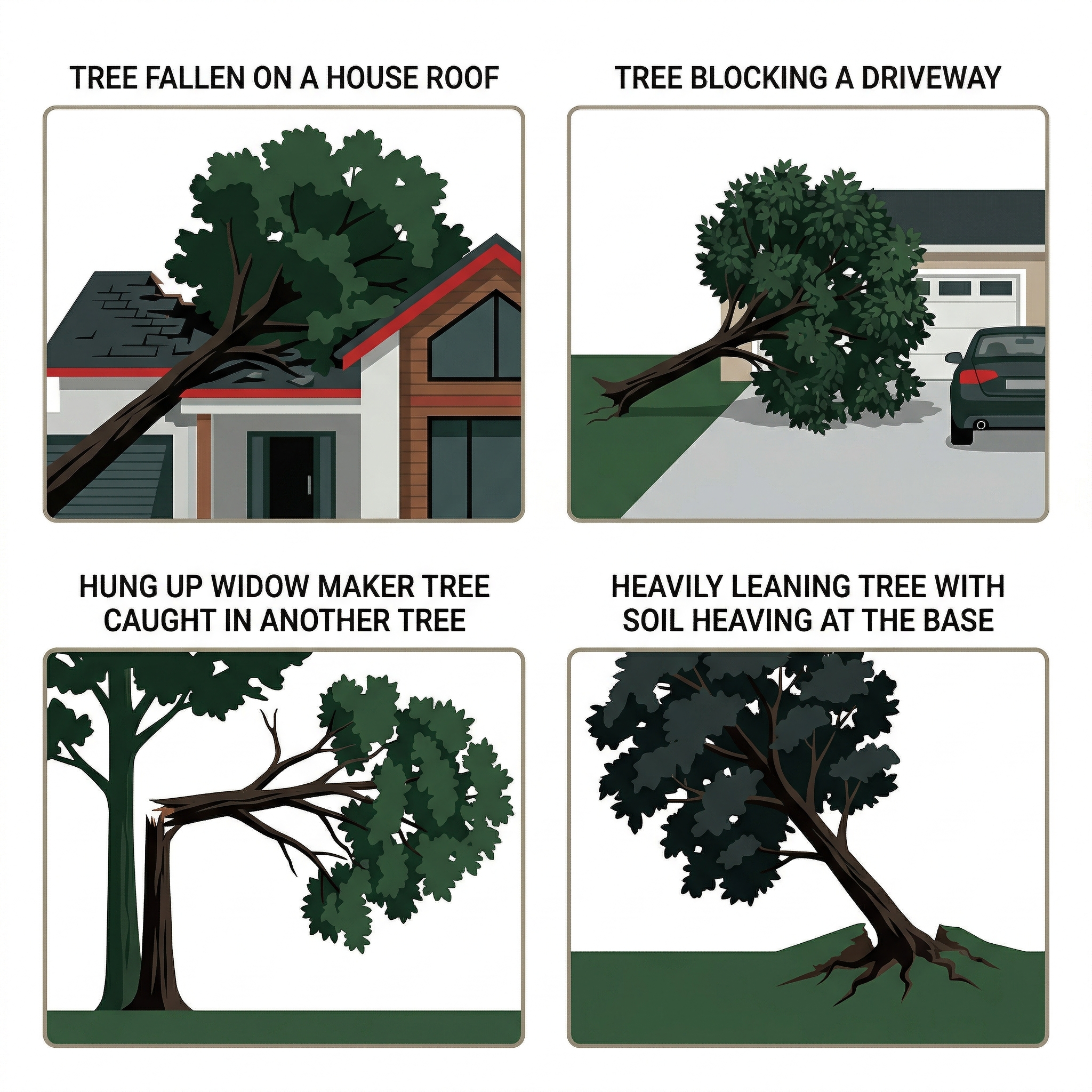
Not every fallen branch is an emergency. From a crew dispatch perspective, a real emergency means the tree is creating an immediate hazard to people, property, or access. The four situations that always justify same-day response:
- The tree is on a structure. Roof, exterior wall, garage, fence, vehicle, or utility line. Even a partial impact can drive structural damage hourly as the tree settles.
- The tree is blocking access. Driveway, sidewalk, fire lane, or the only entrance to a home. NYC fire code requires emergency vehicle access; a tree blocking your driveway is also blocking the FDNY.
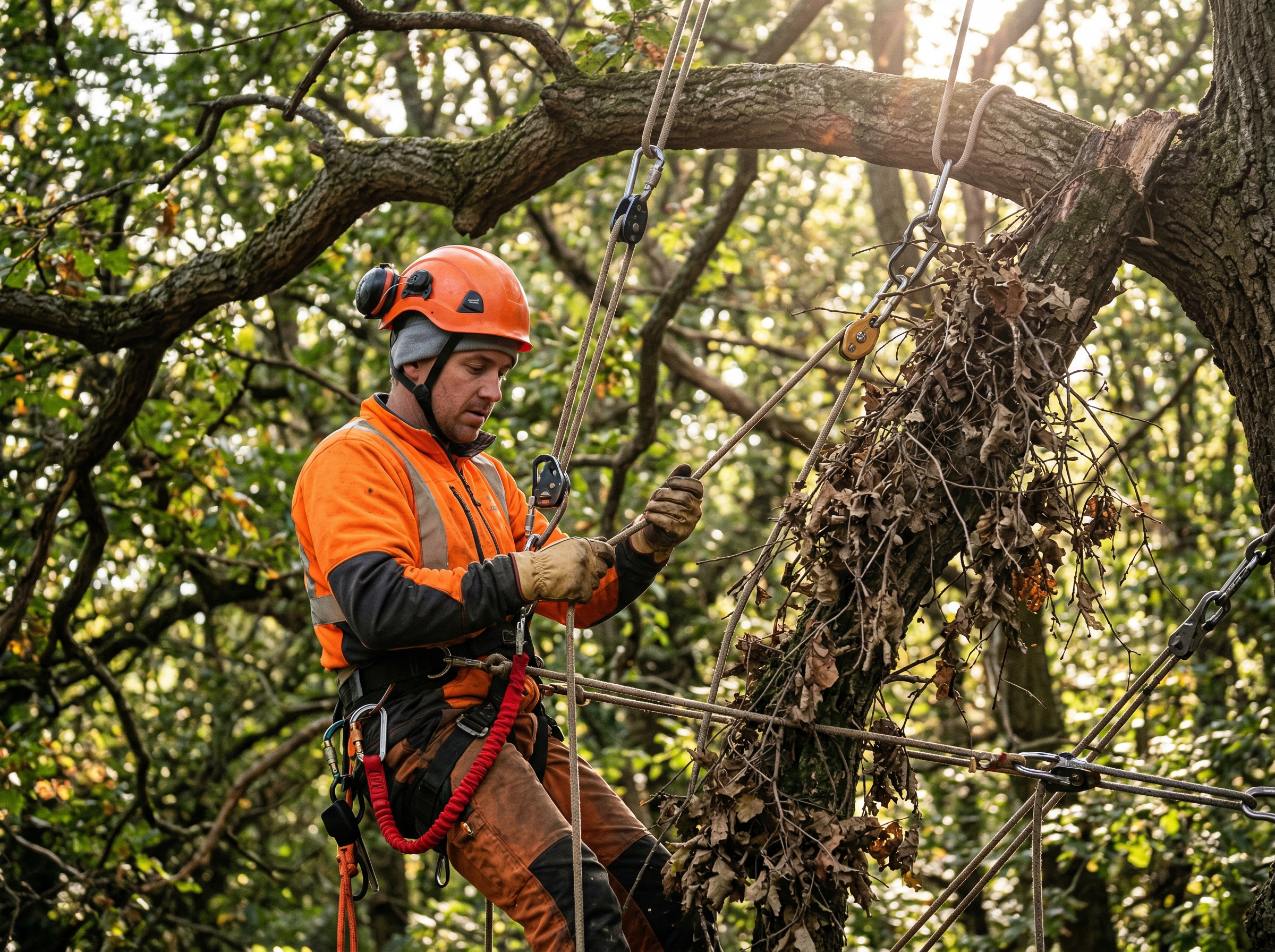
- The tree is hung up. A “widow maker” is a fallen or broken tree caught in another tree, on a power line, or on a building, suspended in tension. These are the most dangerous removals in the trade because the load can release without warning.
- The tree is leaning hard after wind, ice, or root failure. If the trunk has shifted from vertical and the soil around the root flare is heaving, the tree is failing. It will come down on its own timeline, not yours.
Things that are not emergencies, even when they feel like one: a single broken branch in the canopy, a tree that “looks dead” with no immediate lean, a stump from an old removal, or storm debris in the yard. Those are routine work and can wait for a daytime appointment at standard rates.
How fast can a real crew actually arrive?
The honest answer depends on three things: the time of day, the weather, and how many other emergencies are running. After a major storm, every reputable NYC tree company is triaging dozens of calls. The crews that actually show up in two to four hours are the ones that already have trucks staffed, climbers on standby, and a chipper hooked up. Operations that subcontract or that only run during business hours will quote you “tomorrow morning” no matter what time you call.
For a typical isolated emergency in Brooklyn, Queens, the Bronx, Staten Island, or Manhattan, expect a 90-minute to 4-hour arrival window from a properly staffed crew. After a borough-wide storm event, expect 12 to 48 hours unless there is active life safety risk, in which case FDNY and Con Edison take priority over private property removal.
Why a crane often shows up
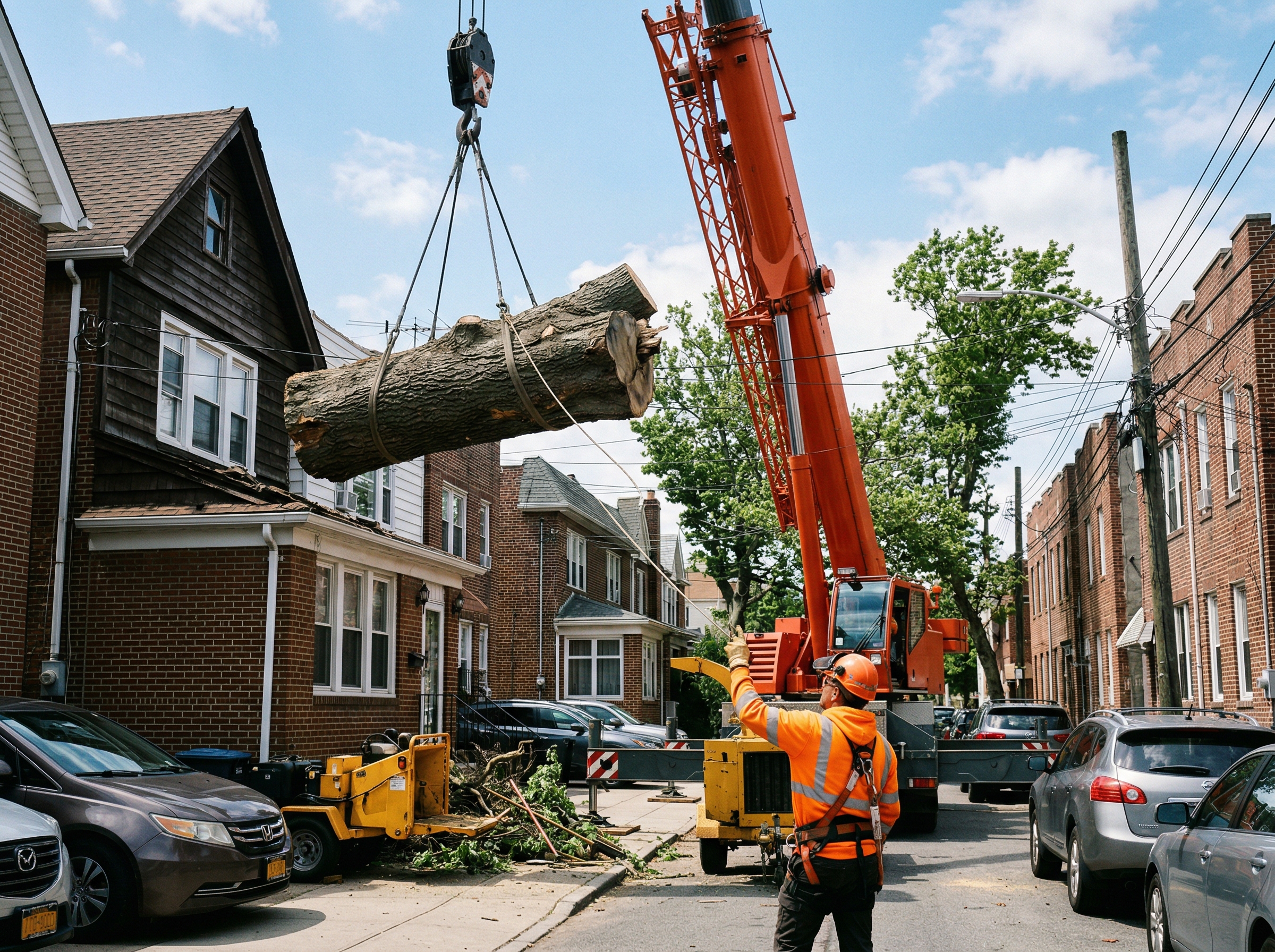
About a third of NYC emergency removals get a crane on site. Cranes do three things you cannot do safely with rope and rigging alone:
- Lift the load off whatever it is resting on. A 4,000-lb section of trunk on your roof has to come up, not down. A crane picks it cleanly and carries it to the street.
- Reach over the structure. When the climber cannot get above the work, the crane operator can.
- Reduce climber exposure on a compromised tree. If the trunk is split or hung up, no climber is going up it. The crane operator does the work from the cab.
Cranes add cost (a typical NYC crane day-rate runs $2,500 to $6,500 in 2026), but they also cut hours off the removal and dramatically reduce the risk of additional damage during the take-down.
What an emergency removal actually costs in 2026 NYC
Emergency pricing is different from routine pricing for three reasons: after-hours labor, equipment mobilization on short notice, and the higher risk profile of compromised trees. Rough 2026 NYC ranges, for reference, not for quoting:
- Small emergency (single tree, no crane, accessible): $1,200 to $3,500
- Medium emergency (large tree on structure or fence, crane optional): $3,500 to $9,000
- Large emergency (full mature tree on a house, crane required): $8,000 to $25,000+
- Storm response with crew + crane + traffic control: $12,000 to $40,000+
Add 30 to 60 percent for after-hours work (nights, weekends, holidays). Add 15 to 25 percent for tight access (no street parking, no truck approach, narrow Brooklyn or Queens lots). Permits from NYC Department of Parks & Recreation Forestry are required if the tree is on city property or if the work blocks a street; on a true emergency the crew calls the city after the fact, not before.
Insurance: what is covered and what is not
This is where most NYC homeowners get surprised. Standard homeowner policies (HO-3 and HO-5) handle tree damage in a fairly specific way:
Covered
- Damage to your structure. Roof, walls, fence, garage, deck, attached structures.
- Removal of the tree from the structure. Most policies cap this at $500 to $1,500 per tree, with a per-event aggregate cap (often $1,000 to $3,000 total).
- Damage to vehicles. Falls under your auto comprehensive coverage, not homeowners.
- Loss of use. Hotel costs if your home is uninhabitable during repairs.
Not covered
- Removing a tree that fell in the yard but did not hit anything. Even if the tree was healthy, even if the storm caused it. The carrier’s logic: it cost you nothing to leave the tree where it fell. You can dispute this; you will usually lose.
- The full removal cost above the policy cap. If a $12,000 removal is needed and your policy caps tree removal at $1,500 per event, you pay $10,500.
- A tree that was already dead or visibly dying. Carriers can deny claims by arguing the homeowner failed to maintain the tree. This is why the NYC Department of Parks & Recreation Forestry hazard reports and ISA arborist documentation matter.
- Damage to a neighbor’s property from your tree, when your tree was healthy. Their insurance pays. Yours only kicks in if your tree was in known dangerous condition.
What to do in the first 30 minutes
If a tree comes down on or near your property:
- Get everyone away from the tree. Compromised trees release tension unpredictably. Distance yourself by at least the length of the tree.
- If utility lines are involved, call 911 and Con Edison (1-800-752-6633). Do not approach the tree under any circumstances. Treat every downed line as live until Con Edison clears it.
- Photograph everything before anyone touches it. Wide shots, close shots, the root flare, the impact point on the structure, the surrounding area. These photos are the foundation of your insurance claim.
- Call your insurance carrier’s 24-hour claim line. Open the claim immediately even if you do not have a damage estimate yet. Get a claim number. Note the adjuster’s name and contact.
- Call a licensed tree removal company. Get them on site for assessment and stabilization. The crew can tarp the roof, secure the tree, and write a written scope before full removal begins.
- Report to NYC 311 tree emergency reporting if a city tree or city property is involved. The city handles its own trees and bills the rest accordingly.
How to vet an emergency tree company at 2 a.m.
Storm-chasers are real. After every NYC nor’easter, dozens of out-of-state crews drive in, knock on doors, and quote cash prices for immediate removal. Some are legitimate. Many are not insured, not certified, and disappear if anything goes wrong. Three questions that filter the field in 60 seconds:
- What is your NY State business registration and your NYC DCWP license number? Reputable companies answer instantly.
- Can you email me your certificate of insurance with my address listed as additional insured before you start? Required by every legitimate carrier; takes 5 minutes from the office.
- Is your lead climber an ISA Certified Arborist or TCIA CTSP? The International Society of Arboriculture maintains a public certification verification page. Anyone can confirm in 30 seconds.
If a crew refuses to provide any of the above, walk away. The few hundred dollars you might save is not worth the lawsuit when an uninsured worker gets hurt on your property.
Frequently asked questions
Is emergency tree removal really more expensive than routine removal?
Yes, typically 30 to 60 percent more for after-hours labor, plus mobilization fees for staffing equipment outside normal scheduling. The premium is real and not negotiable on legitimate emergencies. If a crew quotes you the same price as a routine job, ask why; it usually means they cannot actually respond within the window you need.
Will insurance pay for the tree removal if no structure was hit?
Almost never. The standard HO-3 / HO-5 language only covers tree removal when the tree damages a covered structure. A tree that falls in your yard, even from a healthy specimen during a storm, is your removal cost. The exceptions are limited and usually small.
What if the tree fell from my neighbor’s yard onto my house?
Your insurance handles the damage to your property and the removal from your structure, then their adjuster pursues subrogation against the neighbor only if the tree was in documented dangerous condition. If their tree was healthy and a storm took it down, that is treated as an “act of God” and stays with your carrier.
Do I need a permit to remove a tree on my own NYC property after it falls?
For a tree entirely on private property, no permit is required to remove it. If any part of the tree is on city property (street tree, park tree, sidewalk), or if removing it requires blocking a street or sidewalk, the city must be notified. Reputable crews handle the call to NYC 311 tree emergency reporting and DPR on your behalf.
Will a crane operator come out at night?
Yes, but only if the situation justifies it. Night crane work is the most expensive option in tree care: typically $4,000 to $8,000 just for the crane and operator before the climbers and ground crew. For a tree on a house creating ongoing structural damage, the cost is justified. For a tree blocking a driveway with no structural impact, it can wait until morning.
The honest summary
Emergency tree removal in NYC is straightforward when you know what to expect: real emergencies justify the premium, insurance covers the structure damage but rarely the full removal cost, and the crews that show up fast are the ones that actually staff for it. Document everything for your insurer, vet your crew, and do not let a stranger talk you into a cash deal at 2 a.m. If you have a tree down right now or want to be on a priority list before the next storm, request a free estimate and we will walk through the response options for your specific property.