
You walk down to your basement and see it: a jagged, spiderweb crack inching its way across the concrete. Or maybe your patio has started to heave upwards, creating a tripping hazard. You look out the window, and there it is your neighbor’s massive Oak or Maple, looming over the fence, its roots clearly the underground culprits.
Your first instinct might be to hand the bill for the foundation repair to the neighbor. After all, it’s their tree, right?
Here is the hard truth: In most property disputes, including here in New York, it is rarely that simple. The law doesn’t always see tree roots as a “trespass.” Instead, it often views them as a natural occurrence, which shifts the financial burden in ways you might not expect. Before you call a lawyer or start digging a trench, you need to understand where your rights end and your neighbor’s liability begins.
The “Act of God” vs. Negligence: The Legal Gray Area
In the world of arboriculture and property law, liability usually hinges on one word: Negligence.
If your neighbor’s tree is healthy, vibrant, and well-maintained, but its roots just happen to wander into your yard and push against your foundation, the courts often classify this as a natural event. In many jurisdictions, a healthy tree damaging a neighbor’s property is considered an “Act of God.”
What does this mean for your wallet?
In this scenario, your neighbor is likely not responsible for the damage. If the tree is healthy, you are generally responsible for protecting your own property. Your neighbor didn’t plant the roots with the intention of cracking your basement; biology just took its course.
However, the script flips entirely if the tree was negligent.
If the tree was visibly dead, decaying, or known to be unstable before the damage occurred, and the neighbor ignored it, they could be liable. This is why regular inspections are vital.
The “Self-Help” Rule: Your Right to Cut (With a Catch)
So, if the neighbor isn’t paying, can you just hack away the roots on your side of the property line?
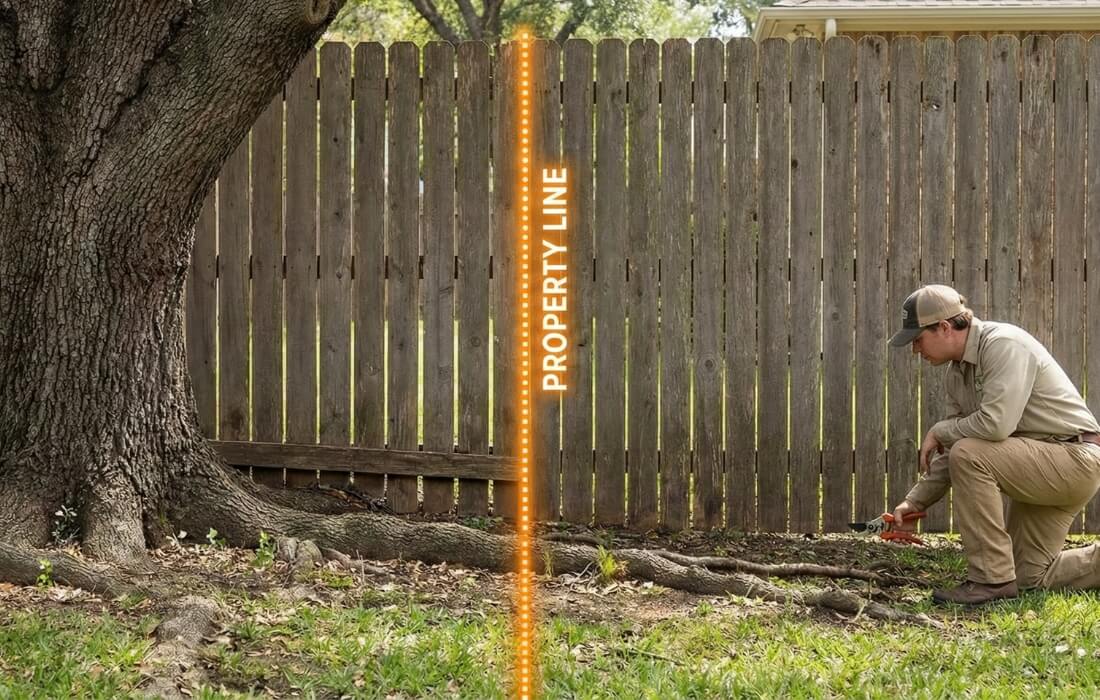
Generally, yes. Under what is often called the “Self-Help” rule, you typically have the right to trim branches and roots that encroach onto your property, up to the property line. You do not need the neighbor’s permission to defend your foundation.
But here is the massive warning:
You cannot kill the tree.
If you aggressively sever major structural roots to save your foundation, and that tree subsequently dies or topples over (crushing the neighbor’s garage), you could be liable for the value of the tree and the damages.
This is a delicate balance. You need to stop the encroachment, but you must do it in a way that preserves the tree’s health. This is where professional root pruning comes in it’s surgery, not a demolition.
Proving the Source of the Damage
Before you escalate a conflict, you need to be 100% sure those roots are actually the problem. Concrete foundations crack for many reasons: settling soil, water pressure (hydrostatic pressure), and poor construction.
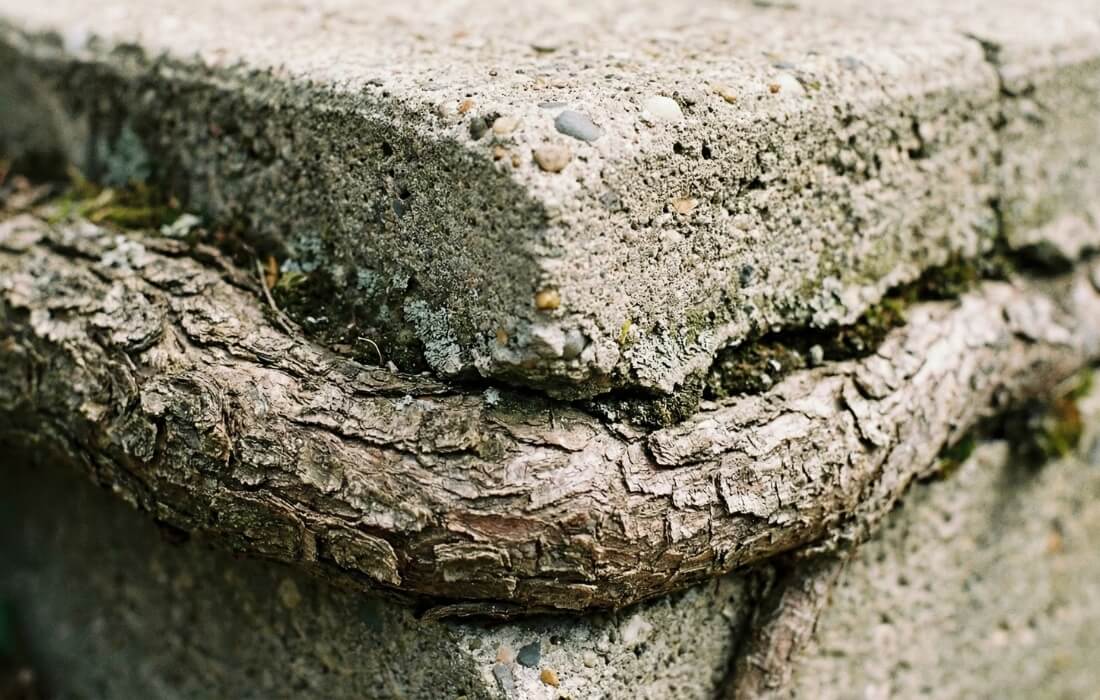
Tree roots are opportunistic. They often don’t cause the crack; they find a tiny, pre-existing hairline fracture caused by moisture and grow into it, making it wider.
If you are going to approach your neighbor (or a judge), you need proof.
- Document the growth: Take photos of the roots and the damage.
- Get a professional opinion: Don’t guess. A structural engineer or a certified arborist can tell you if the roots are the primary cause or just a secondary symptom.
Note: Roots are often searching for water. If your foundation has drainage issues, you are essentially inviting the roots in. Sometimes, the damage is more related to plumbing leaks than the tree itself. We’ve seen cases where tree roots seek out plumbing lines, causing backups that get blamed on the foundation.
The Action Plan: How to Handle the Situation
If you are staring at a cracked foundation and a stubborn neighbor, follow this protocol to protect your home and your bank account.
1. Talk Before You Chop
Walking over to your neighbor and having a calm conversation is the cheapest solution. They might not even know their roots are causing issues. In some lucky cases, they might offer to split the cost of root pruning or even tree removal if they were thinking about taking the tree down anyway.
2. Install a Root Barrier
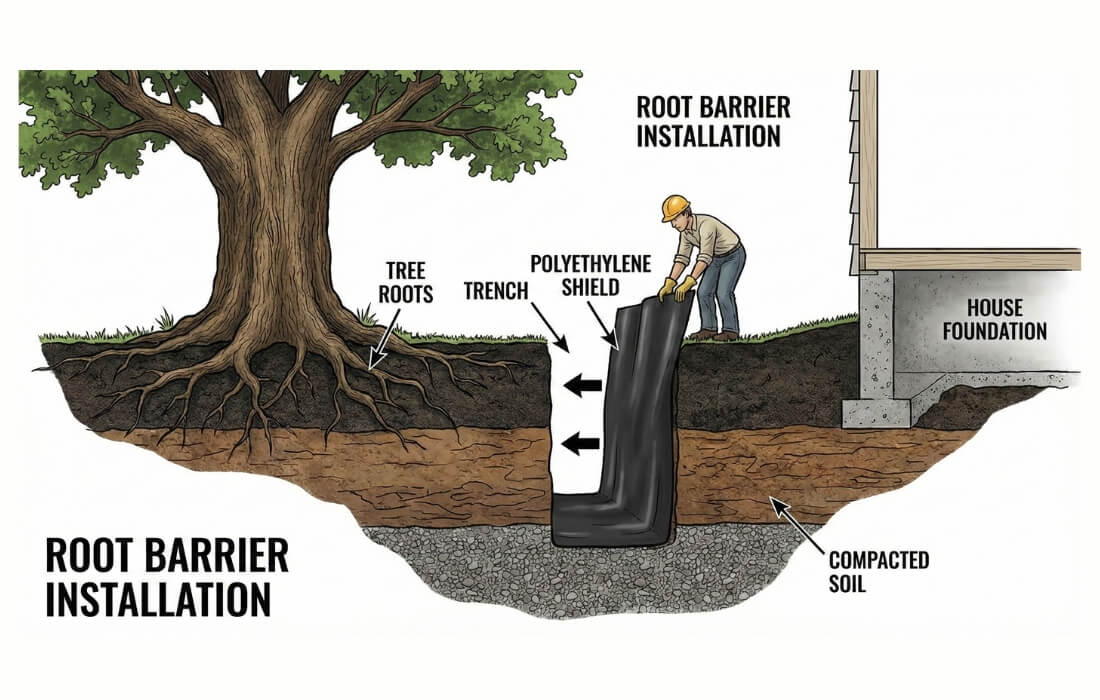
This is often the best long-term solution. A root barrier is a physical shield (usually high-density plastic or metal) buried underground along your property line. It deflects roots deeper into the soil or turns them back, preventing them from reaching your foundation. This allows you to keep the neighbor’s tree (and the shade) while protecting your structure.
3. Check Your Homeowners Insurance
Does insurance cover this? usually, no. Standard policies cover “sudden and accidental” damage (like a tree falling on your roof). They rarely cover “gradual damage” like roots pushing through a wall over five years. However, if a root ruptures a pipe causing sudden water damage, that might be a different story.
Is Legal Action Worth It?
Suing a neighbor over tree roots is rarely a slam-dunk case. Unless you can prove they were negligent (i.e., they knew the tree was dead/dangerous and did nothing), you will likely spend more on legal fees than the cost of the repair.
For reliable information on property disputes and “nuisance” laws, resources like FindLaw’s Neighbor Dispute section offer excellent general guidelines on where property lines stand legally.
Protect Your Foundation Without a Feud
At the end of the day, your foundation is your responsibility. While it’s frustrating that a neighbor’s tree is the cause, the law usually puts the ball in your court to mitigate the damage.
The smartest move is proactive defense. Don’t wait for the wall to buckle. If you see roots heading toward your home, or if you are planning to cut roots and are terrified of killing the neighbor’s tree (and getting sued), you need a professional Tree Risk Assessment.
We can help you determine if the roots can be safely pruned, if a barrier is feasible, or if we need to have a deeper conversation about removal.