
Quick Solution: How to Estimate Tree Age Without Cutting It Down
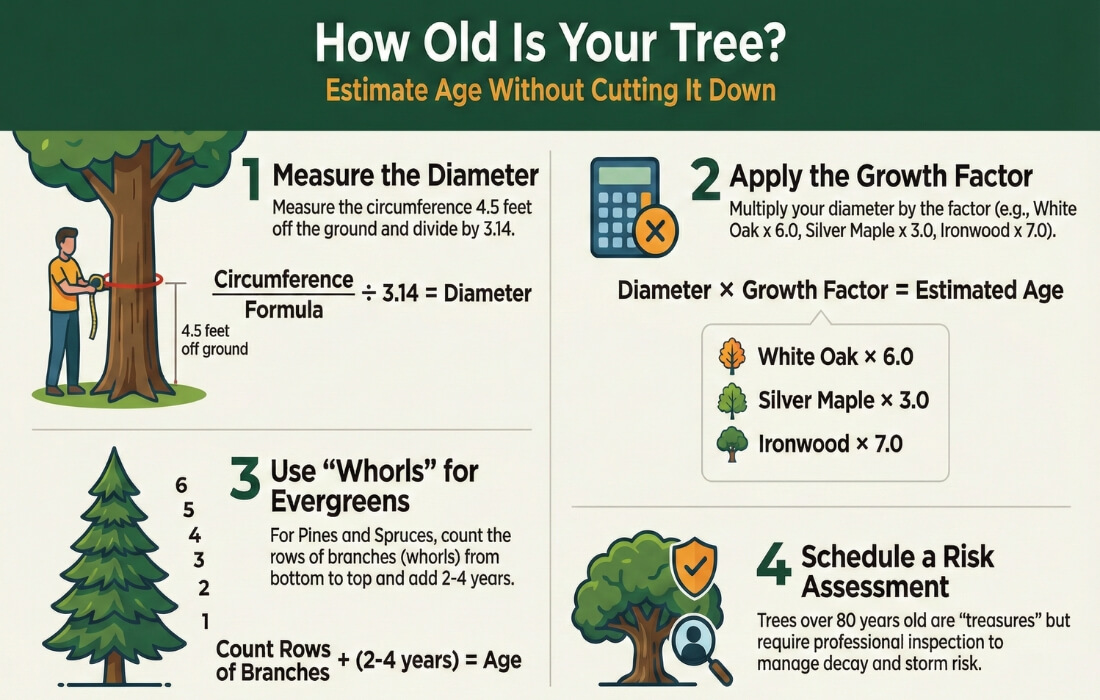
The most accurate non-invasive method is the International Society of Arboriculture (ISA) Growth Factor Formula. Follow these 3 steps:
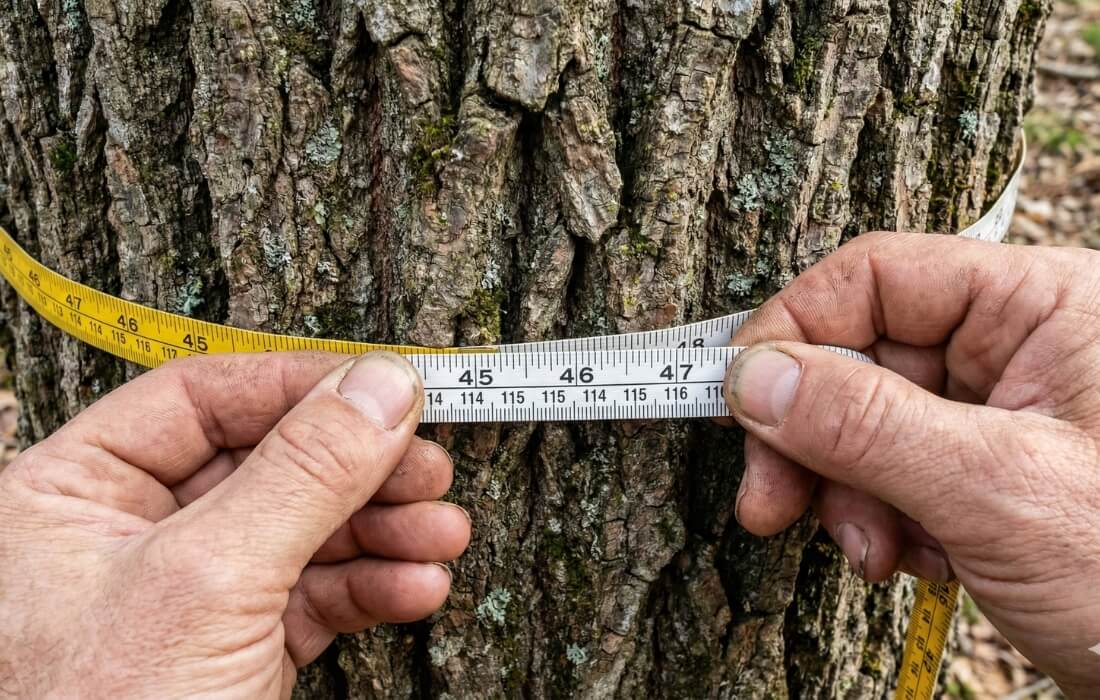
- Measure Circumference: Wrap a tape measure around the tree trunk at breast height (approx. 4.5 feet off the ground).
- Calculate Diameter: Divide the circumference by 3.14 to get the trunk’s diameter in inches.
- Multiply by Growth Factor: Multiply the diameter by the specific Species Growth Factor (e.g., x 4.0 for Red Oak or x 5.0 for Sugar Maple).
The Formula: (Circumference ÷ 3.14) x Species Factor = Approximate Age
Table of Contents
The “Tape Measure Test” (International Society of Arboriculture Method)
1. Measure the Circumference
2. Calculate the Diameter
3. Multiply by the “Growth Factor”
Why Knowing the Age Actually Matters
Context Clues: The History of Your Property
When Old Age Becomes a Safety Issue
Does Your Ancient Tree Need a Check-Up?
You’ve probably heard the old wisdom: “Count the rings to find the age.”
It’s true, dendrochronology (the science of dating tree rings) is the most accurate method. But it has one massive, obvious flaw: You have to kill the tree to do it. Unless you’re looking at a stump, counting rings isn’t an option.
So, when you’re staring at that massive Oak in your Queens backyard or the towering Maple shading your brownstone in Brooklyn, how do you know if it witnessed the turn of the century? You don’t need a chainsaw; you just need a tape measure and a little bit of math.
Here is the professional arborist’s cheat sheet for estimating a tree’s age while keeping it standing tall.
The “Tape Measure Test” (International Society of Arboriculture Method)
If you want to feel like a tree detective, this is the method we use most often for broadleaf trees (deciduous trees that lose leaves). It’s not a wild guess; it’s a formula based on the species’ average growth rate.
1. Measure the Circumference
Grab a flexible measuring tape (like a sewing tape). Measure the trunk’s circumference at breast height, which is standardly defined as 4.5 feet (roughly 1.4 meters) off the ground.
Tip: If the ground is uneven, measure from the uphill side.
2. Calculate the Diameter
Remember high school geometry? To get the diameter, take your circumference and divide it by Pi (3.14).
- Example: If your tree is 63 inches around, 63 ÷ 3.14 = 20 inches diameter.
3. Multiply by the “Growth Factor”
This is the secret sauce. Different trees grow at different speeds. A Silver Maple grows like a weed compared to a slow-burning White Oak. You take the diameter (in inches) and multiply it by the species’ specific Growth Factor.
Here are the Growth Factors for common NYC trees:
- Silver Maple / Pin Oak: x 3.0
- Red Oak / Ash: x 4.0
- Black Walnut / Red Maple: x 4.5
- Sugar Maple / White Birch: x 5.0
- White Oak / Beech: x 6.0
- Ironwood: x 7.0
The Final Math: Using our example above, if that 20-inch diameter tree is a White Oak (Factor 6.0):
- 20 (diameter) x 6.0 (factor) = 120 years old.
That tree was likely planted around 1906!
The “Whorl Method” for Pines and Spruces
If you have a conifer (evergreen) in your yard, the math is even easier no calculator required. Conifers like Pines, Spruces, and Firs grow in distinct cycles.
Every year, these trees put out a new set of branches from the tip of the trunk. These sets of branches are called “whorls.”
- Look at the trunk. You will see rows of branches growing at roughly the same height, encircling the tree. That is one whorl.
- Count the whorls from the bottom to the top.
- Add 2-4 years to account for the seedling stage (before it started making distinct whorls).
The Catch: As trees get older, the bottom branches often die and fall off, and the bark grows over the “scars.” This method is incredibly accurate for young to middle-aged evergreens but gets tricky with ancient giants where the bottom 20 feet of trunk is bare.
Why Knowing the Age Actually Matters (It’s Not Just Trivia)
Beyond bragging rights, knowing the approximate age of your tree helps you care for it. Trees have life cycles just like us.
Young Trees (1-15 years): These need structural training. You aren’t just pruning for looks; you are preventing future failures. If you identify your tree is in this bracket, check our guide on how to train young trees for strong structure..
Mature Trees (30-80+ years): These are your assets. They provide the most shade and property value, but they also carry heavier limbs.
Over-Mature/Veterans (100+ years): These trees are treasures, but they are also more prone to decay, hollows, and storm damage.
If your math tells you that tree is pushing 80 or 90 years old, it is crucial to schedule a Tree Risk Assessment. An old tree isn’t necessarily dangerous, but it does require a different level of respect and inspection than a sapling.
Context Clues: The History of Your Property
Sometimes, the best clues aren’t in the wood they’re in the library.
- Check Old Photos: NYC has incredible archives. If you can find a photo of your street from the 1950s and your tree is a sapling in the background, you have a hard date.
- The “Sidewalk Lift”: While not a precise measurement, massive root flare that is buckling heavy concrete usually indicates a tree that has been fighting for space for decades.
Note on Accuracy: The Growth Factor method is an estimate. Trees in dense forests grow slower (tighter rings) than trees in an open backyard (wider rings) because of competition for sunlight. For a purely scientific analysis without cutting, arborists use an increment borer to extract a tiny core sample, but this is invasive and usually reserved for research. You can read more about how trees grow and age from the Arbor Day Foundation.
When Old Age Becomes a Safety Issue
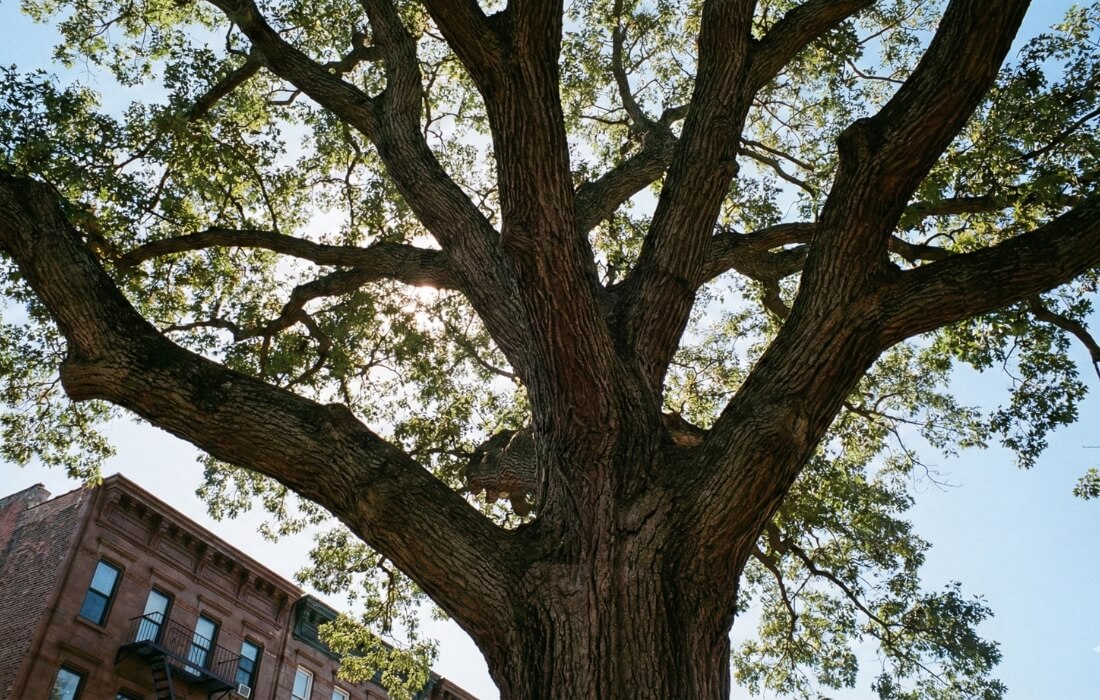
We love old trees. At Dragonetti, we always prefer to preserve them when possible. However, as trees age, their ability to compartmentalize wounds slows down. A storm wound that a 20-year-old Maple would shrug off might rot a 100-year-old Maple.
If your calculation reveals you’re living under a century-old giant, don’t panic just be proactive. Regular maintenance pruning can reduce the weight on those old limbs and extend the tree’s life significantly.
Does Your Ancient Tree Need a Check-Up?
Calculating the age is fun, but ensuring the safety of your home is essential. Whether your tree is a spry 20-year-old or a stately 100-year-old veteran, Dragonetti Tree Removal NYC is here to help it thrive or safely remove it if its time has come.
Unsure about the health of your historic tree? Contact us today for a consultation.